Understanding the Demographic Transition Model: Stages of Population Growth and Decline
90 likes | 230 Views
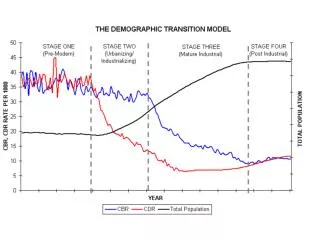
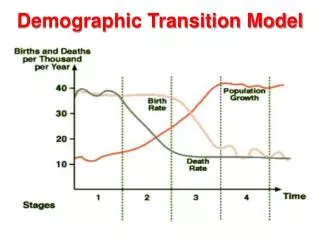
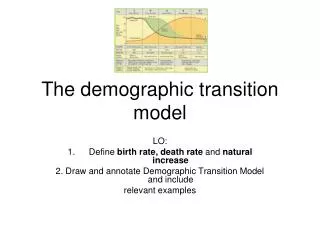
The Demographic Transition Model (DTM) outlines the stages of population change in societies, from low growth with high birth and death rates to potential decline in developed nations. Stage 1 features high crude birth and death rates, characterized by subsistence farming. Stage 2 showcases high growth due to declining death rates amidst industrialization. Stage 3 sees moderate growth with fewer births as urbanization increases. Stages 4 and 5 reveal low growth and potential decline. Critiques highlight that not all countries experience these transitions uniformly, challenging the model's universality.


Understanding the Demographic Transition Model: Stages of Population Growth and Decline
E N D
Presentation Transcript
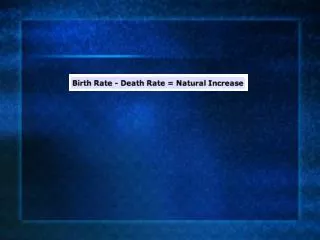
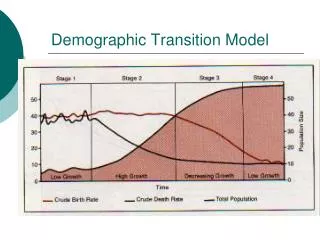
Stage 1: Low Growth (High Stationary Stage) • High CBR (Crude Birth Rate) and CDR (Crude Death Rate) , leading to low RNI (Rate of Natural Increase) • Fluctuation in CDR because of disease, famine, and war • Usually characterizes a subsistence farming country without an industrialized economy
Stage 2: High Growth (Early Expanding Stage) • High CBR: children are still needed on farms • Declining CDR: better health care • Industrialization has begun but families have not realized the changes in society (birth rates do not fall) • The RNI increases; population expansion is at a high rate
Stage 3: Moderate Growth (Late Expanding Stage) • Declining CBR: as families move to cities, they have fewer children. • Women realize they have more options in industrialized economy • RNI is decreasing but still greater than 0
Stage 4: Low Growth (Low Stationary Stage) • CBR & CDR reach equilibrium at low levels rather than the high levels of stage 1 • RNI is low • Seen in modern post-industrial countries with zero population growth
Stage 5 (Slow Decline) • Continuing decline of CBR (France, Germany) • Graying-population patterns of wealthier countries
Criticisms of the Model • Based on the European experience • Not all countries will pass through the same demographic transition at the same rate