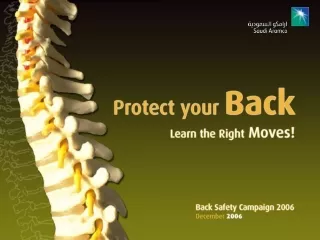
Back Safety Controls
Back Safety Controls. Presented by QBE Loss Control Services. Ergonomic Controls to Prevent Back Injuries. Hierarchy of Controls. Engineering Administrative Personal Protective Equipment. Engineering Controls. Most effective Reduce or eliminate root causes
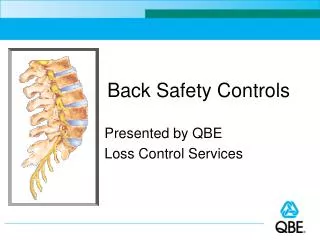

Back Safety Controls
E N D
Presentation Transcript
Back Safety Controls Presented by QBE Loss Control Services
Hierarchy of Controls • Engineering • Administrative • Personal Protective Equipment
Engineering Controls • Most effective • Reduce or eliminate root causes • Physically alter the work environment
Most Important Principles • Can lift be eliminated? • If a person or machine has expended energy to lift an item, it should not be set down until it reaches its final destination
Engineering Controls • Reduce weight of objects • Change way materials moved • Reduce container weights and sizes • Change workstation layout
Engineering Controls • Bring load closer to the body • Raise or lower the origin and destination of lifts (avoid lifts below knees and above shoulder) • Reduce the vertical distance of lift • Move origin and destination closer or farther apart to reduce twisting • Improve object handholds
Administrative Controls • Management directed policies and practices • Do not eliminate hazard • Require employee feedback and close supervision
Administrative Controls • Job rotation • Reduce overtime • Increase recovery periods (more breaks) • Training • Reduce pace of lifting • Stretching or exercise programs • Two-man lift policies • Weight lifting limits
Back Training • Historically the main control for back injuries • Why?-Easy • Largely ineffective
Personal Protective Equipment • Least effective • Relies on each individual to reduce risk factors • Gloves- sharp edges, hot cold surfaces • Proper footwear
Back Belts- NIOSH Study • No differences in rates of injury between employees who wear back belts • No differences in rates of injury in facilities where back belts required • False sense of security • Weaken back muscles if not worn properly • Reduce circulation
Traditional Back Injury Controls • Back schools • Training in proper lifting techniques • Use of back belts
New Approaches to Back Injury Control • Employee selection/pre-placement strength testing • Physical fitness/wellness • JHA (Job Hazard Analysis) • Engineering Controls • Medical management of injured employees/ Transitional Return-to-Work
Prioritization of Controls • Tasks with highest risk factors • Tasks which impact the most employees
Selection of Controls • Will the control reduce risk factors? • Will the control add other hazards to the process? • Will the control increase or decrease productivity? • Is the control feasible? • Will the control be accepted? • How soon can the control be implemented? • Will the control require special Training?
Selection of Controls • Hold brainstorming sessions • Include engineering, maintenance staff, managers, employees • Contact vendors • Contact experts • Contact trade associations
Selection of Controls • Develop list of alternatives • Rate alternatives according to effectiveness and cost • Try to find alternatives that also increase productivity • Use cost benefit analysis or other financial tools • Determine best solution
Selection of Controls • Mock-up to evaluate control • Improve control as necessary • Use mock-up station to train employees • Bring control to full production • Anticipate initial resistance • Do not make final assessment until enough time has past
Evaluation of Controls • Have risk factors been reduced? • Are there less complaints of fatigue and discomfort? • Are injury rates reduced? • Have employees accepted the control? • Have rates of turnover and absenteeism been reduced? • Has there been an increase in productivity?
Lift tables • Positions materials at comfortable height
Lift and Tilt Tables • Lift reduces back bending • Tilt reduces reaching distance
Lift and Swivel Tables • Useful for working with pallets • Lift reduces back bending • Swivel reduces reach
Tilt Tables • Useful for retrieving parts from bins • Reduces back bending • Reduces reach
Turntables • Useful to access several sides of object
Load Levelers • Adjust automatically as weight added/removed • Eliminates back bending • Eliminates reach
Pallet Wrappers • Eliminate grasping forces • Eliminates awkward postures
Pallet Inverters • Useful for material transfers
Pallet Lifters • Useful for pallets • Reduces back bending • Reduces reach • Can move load
Pallet Jacks • Ideal for moving pallets • Reduces risk factors associated with moving objects
Lift Carts • Allows objects to be moved easily • Reduces back bending
Lift and Tilt Carts • Reduced back bending • Reduces reach
Tilt Carts • Useful for small parts transported in bins • Reduces reach • Reduced back bending
Load Leveler Carts • Portability of a cart • Adjust automatically as weight added/removed
Conveyors • Allow objects to be moved pushing/pulling • Can be powered
Articulating Arms • Support weight while load is manipulated • Numerous arm end-effectors available
Vacuum Lifts • Useful for handling bulky items • Useful for unloading/loading pallets
Cranes • Eliminates lifting
Cutout Tote Bins • Allow easy access to bottom of bin
Drop-side Bins • Allow full access to bottom of bin
Drum Carts • Useful for transporting 55 gallon drums
Drum Handlers • Reduces force and poor posture when moving drums
Drum Dumpers • Reduces back strain from awkward postures
Vacuum Cups • Useful for moving loads with smooth surfaces • Allow power grip posture
Construction Work • Less regimented • Rarely follow set routine • Affected by weather, supplies, site conditions, etc.