1 / 6

Types of Chemical Reactions

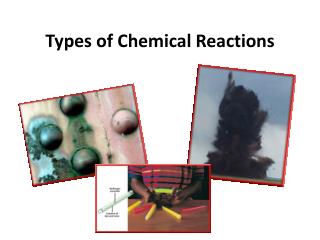
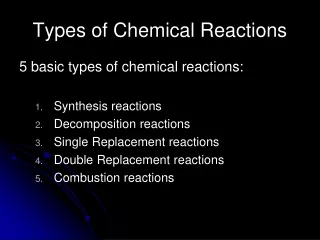
This guide explores the five main types of chemical reactions, including synthesis, decomposition, single displacement, double displacement, and combustion. Synthesis reactions involve combining elements to form a compound (e.g., Mg + O2 → MgO). Decomposition reactions break down compounds into simpler substances (e.g., KClO3 → KCl + O2). Displacement reactions see one element replace another (e.g., Mg + HCl → H2 + MgCl2), while combustion reactions involve a hydrocarbon reacting with oxygen, producing CO2 and H2O (e.g., CH4 + O2 → CO2 + H2O).

pippa
Download Presentation

Types of Chemical Reactions

An Image/Link below is provided (as is) to download presentation Download Policy: Content on the Website is provided to you AS IS for your information and personal use and may not be sold / licensed / shared on other websites without getting consent from its author. Content is provided to you AS IS for your information and personal use only. Download presentation by click this link. While downloading, if for some reason you are not able to download a presentation, the publisher may have deleted the file from their server. During download, if you can't get a presentation, the file might be deleted by the publisher.

E N D

Presentation Transcript


  1. Types of Chemical Reactions

  2. Synthesis • Synthesis: to join together A + B  AB Mg + O2  MgO H2 + O2  H2O

  3. Decomposition • Decomposition: to break apart A B  A + B KClO3  KCl + O2 H2O2  H2O + O2

  4. Single Displacement • Single Displacement: when one element replaces one other element A + BC  B + AC Mg + HCl  H2 + MgCl2

  5. Double Displacement • Double Displacement: when two elements switch places AB + CD  CB + AD KI + CuNO3  CuI2 + KNO3

  6. Combustion • Combustion: When a Carbon based compound (hydrocarbon) combines with Oxygen to make CO2 and H2O CH4 + O2 CO2 + H2O

More Related