Download
1 / 15
150 likes | 262 Views
This document outlines cost-effective interventions and strategies aimed at improving child survival and development from conception to the age of five. It emphasizes the role of antenatal care, early childhood intervention, preventive measures, and effective coverage objectives such as immunization and integrated management of childhood illnesses (IMCI). By implementing a high-impact package of strategies, the goal is to reduce under-five mortality rates significantly over a seven-year period. The strategies also highlight community-based approaches to increase access to healthcare and enhance the capacity of health systems.

E N D
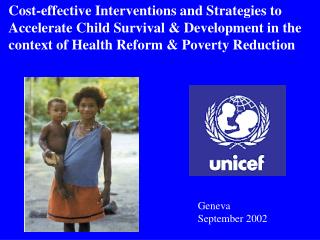
Cost-effective Interventions and Strategies to Accelerate Child Survival & Development in the context of Health Reform & Poverty Reduction Geneva September 2002
From conception to 5th birthday • Antenatal intervention • Early childhood intervention up to 5 years of age • Prevention • Care
EPI PLUS • IMMUNIZATION • VIT A Supplementation • Deworming • Intermittent presumptive Treatement ( linked with EPI once cleared with WHO TDR/ research action)
IMCI plus • Anti Malarial drugs( early and adequate treatment at home WHO TDR research action) • ITNS • ARI Treatment, pneumonia (home or community based, WHO TDR research action) • Oral Rehydration • Exclusif breastfeeding • Iodized salt • Hygien
Antenatal care • Tetanos immunization • Iron Supplement • Intermittent treatment against malaria • ITNS • PMTCT / HIV AIDS
Coverage Objectives Increase effective coverage of : • EPI+ 80%(Immunization, Vit A) • IMCI +50%(prevention and care of malaria, ARI, diarrhea and malnutrition) • ANC 80%(malaria and anemia prevention HIV AIDS)
Impact Objectives: WCAR • Reduce under-five mortality by: • 15% after 3 years of full implementation of high impact intervention packages & strategies; • 25 % after 5 years of full implemen-tation of the interventions/strategies • 35% after 7 years of full implemen-tation of the interventions/strategies (after 7 years a full cohort will have benefitted from -9 months-5 years)
Service Delivery Strategies for the proposed intervention packages. • to 25-50% of population with access to HC(<5km) • Health Centre Based Strategy: integrated delivery of all priority interventions • for 50-75% of population without access to HC. • Community based strategyfor IMCI+ (home based prevention and care) • Outreach/Mobile Strategy: (three) monthly delivery of EPI+ and ANC services
Support Strategies for effective coverage • Social mobilization & communication to improve service use and family care • A results based approach to financing service delivery including performance bonuses (monetary or in kind),contracting with community groups, health staff etc. • Community based monitoring & micro-planning to increase effective coverage and empower communities
Complementarity of Child Survival, SWAp &PRSP 1. Health Sector reforms increase Health System Capacities through enabling health policies, decentralization and partnerships 2. PRSP/HIPCprovides opportunities for: • Increased Financing for Health • Increasing Health Staff Availability/Salaries • Focussing on poorest=high U5MR regions 3. Accelerated Child Survival & Development: • Accelerates Impact of Health Reforms on children • Ensures poverty/disparity reduction for children • Makes the case for additional health sector funding
4 demonstration countriesDistricts of demonstration: 3 millionsRegion for expansion: 7 millions • Senegal • Ghana • Mali • Benin
7 expansion countriespopulation: 4 millions • Gambia • Burkina Faso • Cameroun • Tchad • Niger • Guinea Bissau • Guinee Conakry