Methodology
This study investigates the earthen mortars used in Cremona, Italy, which have extensively been utilized since Roman times. Through the analysis of the historical context and modern methodologies, including petrographic, chemical, and mineralogical evaluations, the research delves into the composition and properties of these mortars. Recent findings suggest these materials were comprised of local soils and fluvial sands, with considerable potential for applications in restoration and conservation. This work aims to provide a deeper understanding of these traditional building materials and their historical significance.

Methodology
E N D
Presentation Transcript
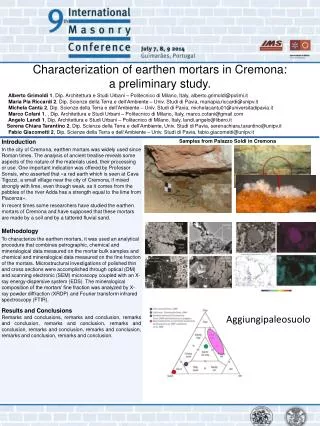
Characterization of earthen mortars in Cremona: • a preliminary study. Alberto Grimoldi 1, Dip. Architettura e StudiUrbani – Politecnicodi Milano, Italy, alberto.grimoldi@polimi.it Maria PiaRiccardi 2, Dip. Scienzedella Terra e dell’Ambiente – Univ. Studidi Pavia, mariapia.riccardi@unipv.it MichelaCantù2, Dip. Scienzedella Terra e dell’Ambiente – Univ. Studidi Pavia, michelacantu01@universitadipavia.it Marco Cofani1, , Dip. Architettura e StudiUrbani – Politecnicodi Milano, Italy, marco.cofani@gmail.com Angelo Landi1, Dip. Architettura e StudiUrbani – Politecnicodi Milano, Italy, landi.angelo@libero.it Serena Chiara Tarantino 2, Dip. Scienzedella Terra e dell’Ambiente, Univ. Studidi Pavia, serenachiara.tarantino@unipv.it Fabio Giacometti 2, Dip. Scienzedella Terra e dell’Ambiente – Univ. Studidi Pavia, fabio.giacometti@unipv.it Introduction In the city of Cremona, earthen mortars was widely used since Roman times. The analysis of ancient treatise reveals some aspects of the nature of the materials used, their processing or use. One important indication was offered by Professor Sonsis, who asserted that «a red earth which is seen at Cava Tigozzi, a small village near the city of Cremona, if mixed strongly with lime, even though weak, as it comes from the pebbles of the river Adda has a strength equal to the lime from Piacenza». In recent times some researchers have studied the earthen mortars of Cremona and have supposed that these mortars are made by a soil and by a tattered fluvial sand. Samples from Palazzo Soldi in Cremona Methodology To characterize the earthen mortars, it was used an analytical procedure that combines petrographic, chemical and mineralogical data measured on the mortar bulk samples and chemical and mineralogical data measured on the fine fraction of the mortars. Microstructural investigations of polished thin and cross sections were accomplished through optical (OM) and scanning electronic (SEM) microscopy coupled with an X-ray energy-dispersive system (EDS). The mineralogical composition of the mortars’ fine fraction was analyzed by X-ray powder diffraction (XRDP) and Fourier transform infrared spectroscopy (FTIR). Results and Conclusions Remarks and conclusions, remarks and conclusion, remarks and conclusion, remarks and conclusion, remarks and conclusion, remarks and conclusion, remarks and conclusion, remarks and conclusion, remarks and conclusion. Aggiungipaleosuolo