Download
1 / 15
150 likes | 244 Views
This cost model study aims to provide precise estimates, identify cost drivers, and ensure cost-conscious design for future improvements. It includes a technical approach involving scaling assumptions for various components like civil engineering, RF structures, and electricity costs. The integration of the cost model into optimization studies is crucial for efficiency. Ongoing efforts focus on improving cost estimates and reducing costs of specific modules to enhance overall project feasibility.

E N D
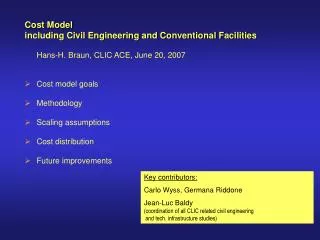
Cost Model • including Civil Engineering and Conventional Facilities • Hans-H. Braun, CLIC ACE, June 20, 2007 • Cost model goals • Methodology • Scaling assumptions • Cost distribution • Future improvements Key contributors: Carlo Wyss, Germana Riddone Jean-Luc Baldy (coordination of all CLIC related civil engineering and tech. infrastructure studies)
Goals of cost study • Get reasonably precise cost estimate • Identify cost drivers and assure cost conscious design • Get cost model scalable in nRF, G and ECM as input for optimization studies
CLIC cost model technical approach • Civil engineering costs from CERN-TS 2001 study (improved study in progress) • For main tunnel equipment (w/o RF structures) steadily improving estimates, but limited accuracy because design is not mature. • For main tunnel RF structures (accelerator and decelerator) estimate based oncost of machining facilities, manpower and material for given production period. • Klystron + Modulator costs from TESLA cost estimate plus some local expert input • Key input for injectors, damping rings, BDS, control system from NLC studywith some cross checks on recent European projects and gut feeling fudge factors • Electriciy costs based on present CERN contracts • The rest is guess work
An error in BDS estimate of 50% • changes total cost by less than 3% • An error in main linac estimate of 50% • changes total cost by almost 20% • Priorities are to improve cost estimateand reduce costs of • Main linac modules • Civil engineering • Drive beam generation
Some technicalities how cost model enters in Alexej’s optimization • Starting point is cost estimate with CLIC note 627 parameterscoded as EXCEL workbook with many worksheets • Add sheet with parameters provided by Alexej and implement scaling with these parameters • Communication with Alexej’s MATLAB optimizations via Windows DDE server • For speed reasons Alexej interpolates in MATLAB on a grid of values pre-computed with EXCEL
Scaling Assumptions as used for Alexej • Tunnel costs based on 2001 TS study, tunnel cost scaled with length Number of turnarounds scaled with Linaclengthpulselength-1 • Number of DB modulator and klystrons scaled with Wpulswith alimit onaverage klystron power, • RF part of electricity costs scaled with figure of merit L/PAC • Betafunctions as function of beam energy kept constant, i.e. number of quadrupoles proportional to linac length • Effective fill factor for regular module kept constant • Two beam module length and number of PETS per module kept constant
Model for accelerating structure cost scaling CHDS’=Cmat_ref’ (f / 30GHz) -3/2 + Cmach_ref’ (f / 30GHz) 3/2 (D / 600)-2/3 This gives a factor 1.51 increase for cost/m from 11.4 GHz to 30 GHz Prices/m for HDS11 prototype increase by factor 1.6 from 11.4 GHz to 30 GHz for Cu and by factor 1.75 for Mo Model for RF network scaling Cper module = Cref (N/ 8)2/3 withNthe number of accelerating structures per module
A remark on electricity cost Present CERN electricity cost is less than one third of ILC assumption For optimization Alexej uses sum of investment + 10 year electricity cost Depending on price/kWh electricity cost has a very different weight
Cost distribution as function of main linac accelerating gradient for nRF=12 GHz Based on a set of parameters from Alexej, parameter meeting 14.11.06
Cost distribution as function of main linac frequency for G=100 MV/m Based on a set of parameters from Alexej, parameter meeting 14.11.06
Scaling of cost with energy based on present nominal parameters
Civil Engineering & Infrastructure Study under way by CERN TS department for CLIC Similar to CERN-TS effort for ILC civil engineering and cost estimate First numbers for underground areas available since last week, work on surface buildings in progress. A study for technical infrastructure (Cooling & ventilation, electric distribution, tunnel services)has just been launched. Complete picture for end 2007
Standard Linac Module # of standard modules: 16748 # PETS: 66992 # AS: 133984
acc. structure waveguide Assembly in the Alignment and tunnel stabilisation 4% 6% Baseline Accelerating supporting system structures 1% 19% Drive beam instrumentation PETS DB Quad 4% 25% Drive beam quadrupole 14% PETS supports RF components 21% Vacuum 6% Standard Linac module cost distribution
Conclusions and Outlook • Scaleable cost model has been established extrapolating from cost estimate for 2005 nominal parameters. This model has been extensively used in optimization. • Consolidation of estimate for new nominal parameters ongoing. • A number of design features is still only performance driven and needsrevision for potential savings. • Subsystems like injectors, DR’s and BDS needs a closer look • For many components we have only rough draft designs, naturally this limits the precision of the overall estimate