Download
1 / 1
20 likes | 171 Views
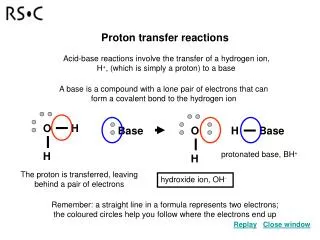
Acid-base reactions involve the transfer of a hydrogen ion (H+) or proton from an acid to a base. A base is characterized by having a lone pair of electrons that can establish a covalent bond with the hydrogen ion, forming a protonated base (BH+). During this process, the proton is transferred while a hydroxide ion (OH-) is generated, leaving behind a pair of electrons. Visual representations, such as straight lines and colored circles, help in tracking electron movements throughout the reaction.

E N D
O H Base O H Base H H Proton transfer reactions Acid-base reactions involve the transfer of a hydrogen ion, H+, (which is simply a proton) to a base A base is a compound with a lone pair of electrons that can form a covalent bond to the hydrogen ion protonated base, BH+ The proton is transferred, leaving behind a pair of electrons hydroxide ion, OH- Remember: a straight line in a formula represents two electrons; the coloured circles help you follow where the electrons end up ReplayClose window