Download
1 / 5
60 likes | 246 Views
This resource explores various models of abnormality in psychology, emphasizing that treatments for disorders like stress hinge on how we interpret and understand these models. It delves into the complexities of human behavior and its multiple causes, including faulty thinking, emotional processes, genetic factors, and behavioral learning. Each model—biological, psychodynamic, cognitive, and behavioral—offers unique insights into the origins of abnormal behavior and provides a platform for evaluating their strengths, weaknesses, and relevant criticisms.

E N D
Models of Abnormality www.psychlotron.org.uk • When we looked at treatments for stress, we saw that the way you try to treat it depends on how you decide to model it • People are complex and their behaviour has many possible causes • We can model behaviour (including abnormal behaviour) in a number of different ways
Thinking Processes Emotional Processes Learned Behaviours Biological Processes Models of Abnormality www.psychlotron.org.uk
Faulty thinking & perception Repressed memories & emotions Genetics Structural damage Chemicals Models of Abnormality www.psychlotron.org.uk Behavioural processes Thinking & emotional processes Conscious Unconscious Biological processes Learning of behaviour
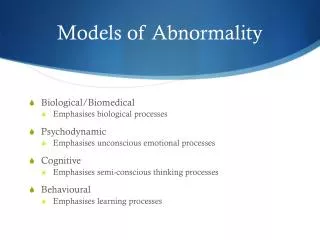
Models of Abnormality www.psychlotron.org.uk • Biological/Biomedical • Emphasises biological processes • Psychodynamic • Emphasises unconscious emotional processes • Cognitive • Emphasises semi-conscious thinking processes • Behavioural • Emphasises learning processes
Models of Abnormality www.psychlotron.org.uk • For each model: • Assumptions about the causes of abnormality • How it explains eating disorders • Strengths & weaknesses; criticisms; evaluation