
Class outline
E N D
Presentation Transcript
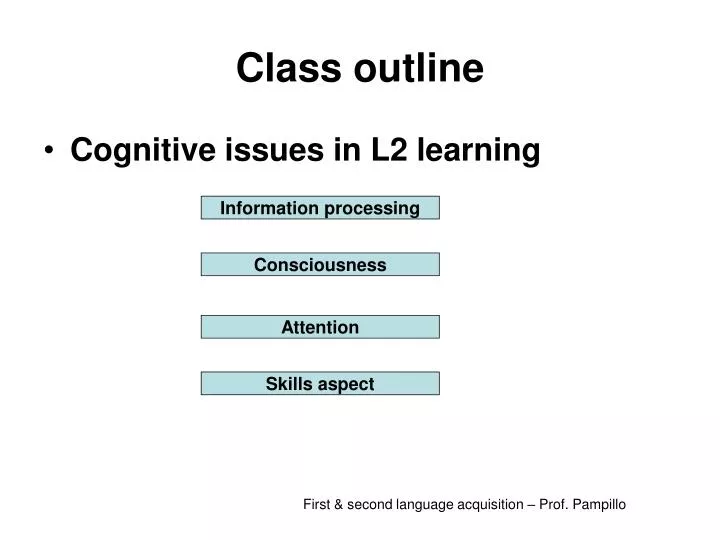
Class outline • Cognitive issues in L2 learning Information processing Consciousness Attention Skills aspect First & second language acquisition – Prof. Pampillo
L2 learning Linguistic aspect Skills aspect First & second language acquisition – Prof. Pampillo
L2 learning Linguistic aspect Skills aspect Explicit and implicit knowledge Controlled & automatic processes First & second language acquisition – Prof. Pampillo
Learners have a limited processing capacity (channel capacity: “room in the mind”) • How can L2 learners maximize this processing ability? • By routinizing skills, that is by automatizing certain processing skills. • By restructuring stored information First & second language acquisition – Prof. Pampillo
Automization (Johnson, 2001): • When a skill is newly learnt it takes up a great deal of conscious attention (channel capacity) • Lower level skills must become automatic (e.g. tense, differentating sounds this/thing, etc) for higher level skills to occur (ensure a message is properly conveyed). • How? For example, by giving the learner increasingly demanding activities, pushing him towards producing the tense with less and less channel capacity available. First & second language acquisition – Prof. Pampillo
Controlled processes: • Short-term memory • Require attention & effort • Operate in linear sequence First & second language acquisition – Prof. Pampillo
Automatic processes: • Long-term memory • No attention required • Operate in parallel First & second language acquisition – Prof. Pampillo
Restructuring (McLaughlin in Johnson, 2001): As people learn, the way they “view” what they are learning changes. Example: Simple mathematical problem of adding up ten twos. • (2+2=4+2=6 and so on) Restructuring 2. (2x10=20) First & second language acquisition – Prof. Pampillo
The role of attention: Noticing • Does input processing require noticing features in the input, that is, conscious attention? Noticing • Features in the input are attended to and so become intake (stored in temporary memory), but may or may not be subsequently accommodated in the interlanguage system. First & second language acquisition – Prof. Pampillo
Attention: “The control process that transfers information into focal awareness.” (Schmidt, 1990) Noticing the gap • Schmidt and Frota suggest that for noticed input to become intake, learners have to carry out a mental comparison of what they have observed in the input with what they are producing (output). First & second language acquisition – Prof. Pampillo
FACTORS THAT FAVOR NOTICING • FREQUENCY • PERCEPTUAL SALIENCE: how prominent is a form? (Cf. unstressed forms) • INSTRUCTION: The role of instruction is not necessarily in the clarity or explanation it provides, but rather in the way it channels attention and brings L2 features into awareness • (Schmidt´s learning experience: what had been unstructured undifferentiated input became noticeable and analyzable.) First & second language acquisition – Prof. Pampillo
OUTPUT in SLA • “Practice makes perfect” Audiolingualism (Behaviorism, 60s) • Only a sign of the second language acquisition that has taken placeKrashen (80s) First & second language acquisition – Prof. Pampillo
SKILLS ASPECT LINGUISTIC ASPECT Rediscovering OUTPUT in SLA First & second language acquisition – Prof. Pampillo
SKILLS ASPECT FLUENCY Rediscovering OUTPUT in SLA • Proceduralization of declarative knowledge (ACT*Model) • Routinization (Mc Laughlin) First & second language acquisition – Prof. Pampillo
LINGUISTIC ASPECT The Output Hypothesis (Swain, 1995) ACCURACY (Form & function in a context-sensitive task) • “PUSHED” OUTPUT • Helps to stretch interlanguage to meet communicative goals (p.127) • Has a role in the development of syntax and morphology (p.128) Rediscovering OUTPUT in SLA First & second language acquisition – Prof. Pampillo
Endangered Species First & second language acquisition – Prof. Pampillo
Teachers: Endangered Species First & second language acquisition – Prof. Pampillo
Teachers are leaving their profession at an alarming rate. 2. A recent poll showed that the number of teachers with more than twenty years´experience has dropped by half in the last fifteen years. First & second language acquisition – Prof. Pampillo
3. One third of the teachers contacted in the poll said that they would not choose teaching if they had the chance over again. • 4. Only sixty per cent of those polled said they planned to teach until retirement. First & second language acquisition – Prof. Pampillo
5. Many interviewed said that factors like stress isolation, powerlessness, and alienation had contributed to the current climate of dissatisfaction within the profession. First & second language acquisition – Prof. Pampillo
DICTOGLOSS (also dictocomp) WHAT IS A DICTOGLOSS? • Note-taking of a text • Individual reconstruction • Small group reconstruction • Error analysis First & second language acquisition – Prof. Pampillo
FEATURES • Context-based task procedure designed to help L2 students towards a better understanding of how grammar works on a text basis First & second language acquisition – Prof. Pampillo
Learner-needs based: exposes learner´s language shortcomings • Interaction provides scaffolding for SLA • Teaching while testing First & second language acquisition – Prof. Pampillo
STEPS • Preparation: arouse interest / pre-teach vocabulary / explain stages of procedure /organize learners in groups First & second language acquisition – Prof. Pampillo
Dictation: • Learners just hear the dictation • Learners write down content words • Text is dictated at normal spoken speed • Pauses are made between sentences (5´´) First & second language acquisition – Prof. Pampillo
Reconstruction: • Individual reconstruction of text • Collective reconstruction through “scribe” • Teacher monitors but does not help • Teacher may help to correct peripheral errors First & second language acquisition – Prof. Pampillo
Analysis and correction: • The first sentence of each group is discussed • Original text´s sentence is shown First & second language acquisition – Prof. Pampillo
CONTRIBUTION TO SLA • Learners understand and use grammar in discourse • Learners develop explicit knowledge by reflecting on their hypotheses (negotiation about form) • Motivation is fostered by spotting learners´ language needs and satisfying affiliation needs First & second language acquisition – Prof. Pampillo
The Output Hypothesis Function 1: Noticing/Noticing the gap • Consciousness-raising role • Notice an L2 feature or a gap in interlanguage Function 2: Implicit Hypothesis-testing • Trying out new forms (well-formedness and comprehensibility) • Stretch interlanguage to meet communicative needs • Modified or reprocessed utterances represent the leading edge of a learner’s interlanguage First & second language acquisition – Prof. Pampillo
The Output Hypothesis Function 3: Explicit hypothesis-testing (Metalingual function: Conscious reflection, Swain) • Negotiation about form in the context of a meaning-based task (E.g. Dictogloss, planned conversations, etc) • Context-sensitive knowledge of grammar (form, function and meaning) First & second language acquisition – Prof. Pampillo
Dialogic interaction & SLA Vygotsky (1986) • cognitive processes arise from interaction inter-mental intra-mental (linguistic change) Donato • Scaffolding (supportive conditions to outperform competence) • L2 features in 80% of negotiated solutions were learned in post-tests First & second language acquisition – Prof. Pampillo
Vygotsky´s Zone of proximal development: The distance between the actual developmental level as determined by independent problem-solving and the level of potential development as determined thru problem-solving under adult guidance or in collaboration with more capable peers (scaffolding). First & second language acquisition – Prof. Pampillo
Information gap activity. Instructions for drawing. Example of negotiation of meaning. What type of knowledge does it contribute to? A: A man is uh drinking c-coffee or tea with the saucer of the uh uh coffee set is uh in his knee B: In him knee A: uh on his knee B: Yeah A: on his knee B: so sorry. On his knee (Gass and varonis 1986:81) First & second language acquisition – Prof. Pampillo
Dictogloss. What type of knowledge does it help to develop? Example: Keith and George are trying to determine whether the correct form is nous tracasse or nous tracassons. Keith: Nous tracassons George: Oh (beginning to realize what is happening) Keith: Yeah? George: The problems which are worrying us. Like the …it’s the problems …like, that concerns us. Keith: Yes, but tracasse isn’t it o-n-s? George: Tracasse it’s not a, it’s not a, yeah, I dunno Keith: OK, it says, the problems which worry us. Therefore is tracasse a verb? That you, that you have to conjugate? Teacher: Uh huh. Keith: So is it tracassons? Teacher: It’s the problems which are worrying us. George: Us, it’s, it’s not, it’s not, yeah, it’s the problems, it’s not, it’s not us. Keith: Ah! E-n-t (third person plural ending), OK, OK. First & second language acquisition – Prof. Pampillo
Pedagogical implications Different pedagogical implications arise: • Opportunities for both intentional and incidental language learning are needed • Pedagogy should provide opportunities for practice to ensure that controlled processes are automatized (skill-building) • Pedagogy should find ways of promoting “noticing” (e.g. by means of interpretation tasks) • Pedagogy should focus on developing explicit knowledge and enabling learners to make use to facilitate acquisition. First & second language acquisition – Prof. Pampillo
LET´S RECAP Answer the following questionnaire based on the article by Swain on output. • Why is output referred to as “pushed” output in the article? • How do processes involved in comprehension differ from those involved in production? In general terms, how does pushed output contribute to develop more accurate interlanguages? • Complete: Negotiation of meaning may help to develop ……… knowledge. Negotiation about form may develop ……………… knowledge. • What is the connection between Vygotskyan theory and the metalinguistic function of output? First & second language acquisition – Prof. Pampillo