The Reading e-Science Centre
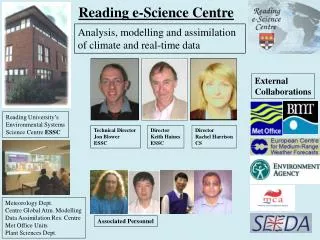
The Reading e-Science Centre, established in November 2003 at the University of Reading, UK, serves as a pivotal hub for environmental e-Science. With joint funding from NERC and EPSRC, the Centre promotes innovative software tools and mapping servers for managing environmental data. It engages industry and government, fostering strong collaborations, especially with British Maritime Technology and the Met Office. Noteworthy projects include the TRACK program for storm tracking, emphasizing the Centre's commitment to improving our understanding of storms and climate change.

The Reading e-Science Centre
E N D
Presentation Transcript
The Reading e-Science Centre Jon Blower Reading e-Science Centre Environmental Systems Science Centre University of Reading United Kingdom
Background • Formed in Nov 2003 as “Centre of Excellence” for environmental e-Science • Joint venture between ESSC and School of Systems Engineering • 50% NERC, 50% EPSRC funding hence joint mission to promote e-Science in environmental sciences and locally at Reading • Since Nov 2005, 100% NERC funded • Hence must focus on NERC activities • Although still active locally
Key activities • Produce software tools for environmental e-Science • Mapping server and interactive website • Secure environmental data server • Linking of NERC clusters at ESSC, Proudman Oceanographic Labs and British Antarctic Survey • Engage with industry and govt agencies • Strong links with British Maritime Technology and Met Office • Research Fellow sponsored by Schlumberger • Encourage uptake of Web Service standards in the community • For greater interoperability • Encourage development and use of local e-Science infrastructure • E.g. Campus Grid • ESSC are key users of current Grid (Kevin Hodges)
Using the Campus Grid: example from ESSC • TRACK program identifies and tracks storms in numerical model output • Identifies pressure lows and vorticity highs • Use Condor to run TRACK over very large numbers of datasets • Datasets are downloaded from the Internet on-demand • Then produce statistics and diagnostics using the results • Tells us about the predictability of storms • Also how storms respond to climate change • Bengtsson et al, 2006 “Storm tracks and climate change” (Journal of Climate) Lizzie Froude, Kevin Hodges, Lennart Bengtsson
Access Grid at ESSC • Internet-based videoconferencing using multicast • Uses InSORS software • Enables distributed meetings between multiple participants • Can share powerpoint slides and other apps • Free to use! • Email us to book accessgrid-resc@rdg.ac.uk