Nuclear Energy
This article explores the two primary types of nuclear reactions: fusion and fission. Fusion involves smashing atoms together to create heavier elements, but it is not yet cost-effective for large-scale energy production. Fission, on the other hand, releases energy by splitting atomic nuclei, driving a chain reaction with significant energy output. We will discuss the safety concerns, the impact of nuclear waste disposal, and infamous accidents like Chernobyl and Fukushima. Learn about radioactive decay, types of radiation, and the implications for our environment.

Nuclear Energy
E N D
Presentation Transcript
Types of Nuclear Reactions Fusion: • Smashing atoms together • Makes heavier element • Not currently cost effective for large scale production Fission: • Energy is released when nucleus is split apart. • 1 g U @ 3 tons coal
The Fission Chain Reaction • A neutron hits U-235 nucleus. • Produces 2 neutrons that hit 2 more atoms of U-235. • And so on, and so on…
Chain Reaction Simulation • Slowed with control rods &/or water • Pros: • No greenhouse gas emissions • Cons: • Thermal pollution of local waterways; can damage local fish & habitats • Mining issues. Most U is U-238; <1% U-235 • Safety concerns
Pressurized Water Reactor (PWR) PWR sim clip
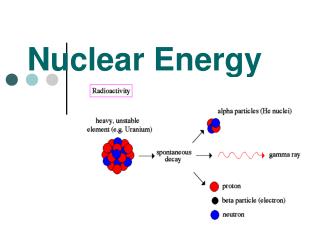
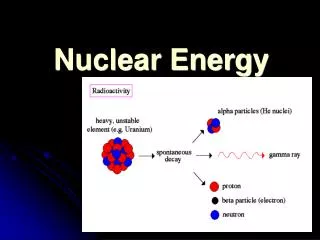
Radioactive Decay • Spontaneous disintegration of nucleus to lighter and more stable particles • Emit one of 3 possible classes of decay…
1. Alpha decay • Alpha Particle He nucleus (2p+, 2n0) • External effect—minimum. Easily stopped. • Internal effect—carcinogenic • Common Source: natural radon, americium-241
2. Beta Decay • Electron emitted. • Tritium, Carbon-14, medical uses • Carcinogenic, can burn skin. Usually chronic exposure, not acute
3. Gamma Radiation • Radium-226, cesuim-137 • Can travel through body, hit all organs • Acute Radiation Sickness: vomiting, burns, kills blood cells, hair loss, death
Decay and Half-Life Half-Life: Time needed for ½ of atoms to decay • Co-60 10.47 minutes • P-32 14.28 days • C-14 5715 years • U-238 4.46 x 10⁹ years
Nuclear Waste Disposal • Byproducts U-234, U-237, Np-237, Pu-238 and Am-241, all radioactive • Wet Storage: on site water tanks • Dry Storage: onsite lead & steel casks • Underground Storage: Centralized. Yucca Mt, NV proposal out of the 2010-11 US budget
Breeder Reactors • Convert U-238 into Pu-239, also fissile • Use liquid Na as coolant instead of water • Pu used as weapons material
Infamous Accidents • Three Mile Island, Pa 1979 • Pump malfunctioned in 2o system • Caused Pressure in reactor to rise & vent. • Vent got stuck open • core temps rose, • partial meltdown occurred • No significant release of radiation
Chernobyl, Ukraine 1986 • Power surge during a test. • Emergency shutdown attempt caused spike in power output. • Reactor vessel ruptured and a series of steam explosions • Graphite moderator caught fire when exposed to air. • Plumes of smoke sent over region • Officially 2 plant workers, 29 emergency workers died as a result, most from acute radiation sickness • Detected in Sweden a few days after explosion
Fukushima, Japan 2011 • Reactors automatically shut down following earthquake & tsunami • Emergency generators came on to keep coolant flowing, but were flooded by seawater • Coolant levels dropped, reactor cores overheated & melted down • H2 buildup in reactors caused explosions into containment buildings • No reported radiation deaths; risks of cancer uncertain