Download
1 / 42
420 likes | 584 Views
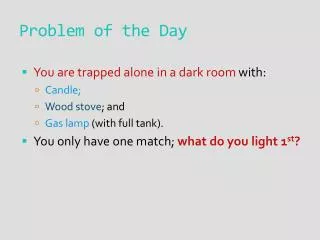
In this engaging riddle, a person looks at a picture and states, "Brothers and sisters I have none, but this man's father is my father's son." The task is to decipher the identity of the man in the picture. The key is understanding the relationships: "my father's son" refers to the speaker themselves, meaning his father's son is him. Therefore, the man in the picture is his son. Join in solving the riddle and enhancing your logical reasoning skills!

E N D
Problem of the Day • A person looks at a picture and says:Brothers and sisters I have none, but this man’s father is my father’s son.Who’s picture is he looking at?
Problem of the Day • A person looks at a picture and says:Brothers and sisters I have none, but this man’s father is my father’s son.Who’s picture is he looking at? • He is looking at a picture of his son.
CSC 212 – Data Structures Lecture 36:Tree Implementation
“Node” Sounds Technical… • Links in linked list commonly called “nodes” • Node is name for links in a Tree also • No relation to linked list class; totally different ideas • Each node’s data retrieved using getElement() • Node class often used by data structures • Node is not specific, but sounds better than “thingy” • More node classes to be seen, we use them a lot
Node Heights • Longest count to leaf node • D's height is 1 • B's height is 3 • A's height is 4 A D B C E G H F K I J
Node Heights • Height 1 more than taller child • F's height is 2 • B's height is 3 • E's height is 1 • Height of leaf always 1 A D B C E G H F K I J
Node Depths • Distance to root node of Tree • A's depth is 0 • C's depth is 1 • I's depth is 3 A D B C E G H F K I J
Node Depths • Depth of a node is1 more than its parent • Root's depth always 0 • B, C, & D have depth of 1 • E, F, G, H have depth of 2 • I, J, K have depth of 3 A D B C E G H F K I J
BinaryTree Interface • All of the methods defined by the interface E getRootElement()boolean contains(tgt)E find(tgt)Iterator<E> iteratorInOrder()Iterator<E> iteratorPreOrder() Iterator<E> iteratorPostOrder() Iterator<E> iteratorLevelOrder() Iterator<E> iterator()int size()booleanisEmpty()
BinaryTree Interface • Often have other methods beyond these in class
BinaryTree Interface • Often have other methods beyond these in class • For example, want methods to addor remove data
BinaryTree Interface • Often have other methods beyond these in class • For example, want methods to addor remove data
BinaryTree Interface • Often have other methods beyond these in class • For example, want methods to addor remove data • Good hint: Used in other ADTs through rest of year
BinaryTreeNodes • BinaryTree interface never exposes nodes
BinaryTreeNodes • BinaryTree interface never exposes nodes CENSORED
BinaryTreeNodes • BinaryTree interface never exposes nodes • Remain implementation-free; nodes detail how it works
Node Class For Tree class TNode<E> {private Eelement;private TNode<E>parent;private ArrayList<TNode<E>>kids;// Besides getters & setters, often include methods like:public TNode<E>getChild(inti) { return kids.get(i);}public void addChild(TNode<E> kid) { kids.addToRear(kid);}public TNode<E>removeChild(inti) { return kids.remove(i); } }
Visualization of Tree B B A D F A D F C E C E
Node Structure of the Tree B B A D F A D F C E C E
Links Between Tree's Nodes B B A D F A D F C E C E
Links Between Tree's Nodes B B A D F A D F C E C E
Actual View of Tree B B A D F A D F C E C E
Linked Node for BinaryTree class BTNode<E>{private Eelement;private BTNode<E>left;private BTNode<E>right;// Add getters & setters for each fieldpublic booleanhasLeftChild(){ return left != null; }public BTNode<E> getRight(){ return right; } }
D C B A Picturing LinkedBinaryTree B A C D
D C B A Nodes in LinkedBinaryTree B A C D
Pointers in LinkedBinaryTree B B A C D A C D
Array-based BinaryTree • Node at index specified for location in Tree • Root node stored at index 0 • Root’s left child at index 1 • Right child of root at index 2 • Left child’s right child at index 4 • Right child’s left child at index 5 • Node at index n’s left child is at index 2n + 1 • Node at index n’s right child is at index 2n + 2
Array-based Implementation • Tree’s depth limited by array size • Where in array determined by location • Listovercomes limits • null added to pad space • Replace value at index to to add nodes
Array-based Implementation • Tree’s depth limited by array size • Where in array determined by location • Listovercomes limits • null added to pad space • Replace value at index to to add nodes
Array-based Implementation • Tree’s depth limited by array size • Where in array determined by location • Listovercomes limits • null added to pad space • Replace value at index to to add nodes
Array-based Implementation • Tree’s depth limited by array size • Where in array determined by location • Listovercomes limits • null added to pad space • Replace value at index to to add nodes • Cannot easily overcome limits • Be careful using this approach
Array-based Impl. A B D C E F J G H
Array-based Impl. A A B D B D E F C J C E F J G H G H
2nd Array-based Impl. A G B D H F C J E A B D C E F J G H
Correct Array-based Impl. A 0 G C E B D F J A 1 2 B D 3 4 5 6 C E F J 9 10 G H H
Array Refers to Nodes A 0 G C E B D F J A 1 2 B D 3 4 5 6 C E F J 9 10 G H H
Nodes Implicitly Linked Only A 0 G B D A 1 2 B D 3 4 5 6 C E F J E F C J 9 10 G H H
Nodes Implicitly Linked Only A 0 G B D A 1 2 B D 3 4 5 6 C E F J E F C J 9 10 G H H
Node for Array-based Impl. public class BANode<E>{private Eelement;privateintmyIndex;privatebooleanhasLeft;privatebooleanhasRight;// Add getters & setters for each fieldpublic intgetLeft() { if (!hasLeft) { return -1; } return (myIndex* 2) + 1;}public void setRight() {hasRight= true; } }
Your Turn • Get into your groups and complete activity
For Next Lecture • Read 12.1 & online for Friday's lecture • What and how does a heap extend BinaryTree? • Why does heap sound familiar, but why is it not? • Can computer science ever be consistent with terms? • Week #13 posted today & due week from Tues. • Programming Assignment #2 available now