Understanding Antiderivatives and Inverse Trig Functions
180 likes | 315 Views
Explore antiderivatives of sin(x)cos(x) and properties of inverse trig functions with examples and derivatives of inverse trig functions. Discover tangent line equations and conversions of trig functions.


Understanding Antiderivatives and Inverse Trig Functions
E N D
Presentation Transcript
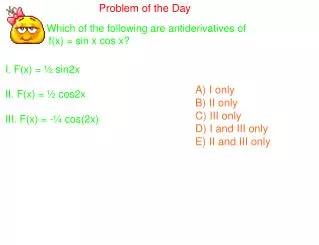
Problem of the Day Which of the following are antiderivatives of f(x) = sin x cos x? I. F(x) = ½ sin2x II. F(x) = ½ cos2x III. F(x) = -¼ cos(2x) A) I only B) II only C) III only D) I and III only E) II and III only
Problem of the Day Which of the following are antiderivatives of f(x) = sin x cos x? I. F(x) = ½ sin2x II. F(x) = ½ cos2x III. F(x) = -¼ cos(2x) A) I only B) II only C) III only D) I and III only E) II and III only
Inverse Trig Functions? How? None of the 6 basic trig functions has an inverse because they are not 1 to 1.
Inverse Trig Functions? How? None of the 6 basic trig functions has an inverse because they are not 1 to 1. Restrict the domain and they do. (see page 373)
sin arcsin (sin y = x) (arcsin x = y) Domain [-π/2, π/2] Range [-1, 1] Domain [-1, 1] Range [-π/2, π/2] cos arccos (cos y = x) (arccos x = y) Domain [0, π] Range [-1, 1] Domain [-1, 1] Range [0, π] tan arctan (tan y = x) (arctan x = y) Domain [-∞, ∞] Range [-π/2, π/2] Domain [-π/2, π/2] Range [-∞, ∞]
sec arcsec Domain |x| > 1 Range [0, π], y≠π/2 Domain [0, π], x≠π/2 Range |y| > 1 csc arccsc Domain |x| > 1 Range [-π/2, π/2], y≠0 Domain [-π/2, π/2], x≠0 Range |y| > 1 cot arccot Domain [-∞, ∞] Range [0, π] Domain [0, π] Range [-∞, ∞]
Evaluate - arcsin(-½) infers that sin y = -½ in the interval [-π/2, π/2], the angle that gives -½ as its sin is -π/6 Evaluate - arcsin(0.3) using a calculator in radian mode y ≈ .3047
Inverse Properties (see page 373) If you are in the restricted interval then tan(arctan x) = x and arctan (tan y) = y Example arctan (2x - 3) = π/4 tan(arctan (2x - 3)) = tan π/4 2x - 3 = 1 x = 2 Similar properties hold true for other trig functions.
Remember the relationship between the derivative of a function and it's inverse?
Remember the relationship between the derivative of a function and it's inverse? Consider the triangle 1 u
1 f(u) = sin u f '(u) = cos u du g(u) = arcsin u u
Find cos(arcsin x) sin = opp = x hyp 1 1. θ 1 2. a2 + b2 = c2 x2 + b2 = 12 b = x 3. cos = adj = hyp 1
Find an equation for the line tangent to the graph of y = cot-1x at x = -1
Find an equation for the line tangent to the graph of y = cot-1x at x = -1 evaluated at x = -1 gives -½ which gives you the slope of the tangent line find y when x = -1 y = cot-1(-1) = π/2 - tan-1)(-1) = π/2 - (-π/4) = 3π/4 find equation of tangent line y - 3π/4 = -½(x + 1)
Conversions sec-1 x = cos-1(1/x) csc-1 x = sin-1(1/x) cot-1 x = π/2 - tan-1(x) Page 378 summarizes all rules learned so far