A Convolution Accelerator for OR1200
This document details the design and optimization of a convolution accelerator for the OR1200 CPU architecture. It introduces convolution concepts, including discrete convolution and its applications in various fields like signal processing and computer vision. The methodology outlines the RTL source code optimization process, physical layout design, and verification through simulations. Key improvements in the design embrace error correction and performance enhancements, aimed at establishing a dedicated hardware solution for efficient convolution operations.


A Convolution Accelerator for OR1200
E N D
Presentation Transcript
A Convolution Accelerator for OR1200 Dawei Fan
5 1 2 3 4 Methodology Conclusion Introduction Physical Layout Design RTL Design and Optimization Contents
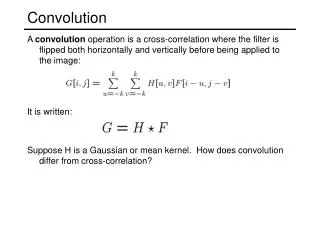
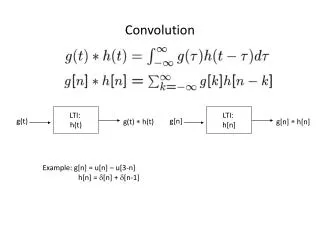
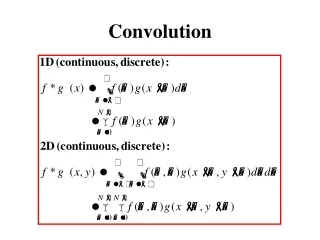
Introduction • What is convolution? • Convolution is defined as the integral of the product of the two functions after one is reversed and shifted. The convolution operation of f and g is denoted as f∗g.
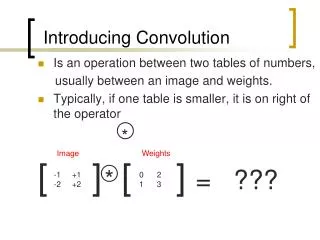
Introduction • Discrete Convolution • Defined on set Z or Z+, rather than R • Convolution is the array of the sumof the product of two arrays after one is reversed and shifted.
Introduction • What is convolution used for? • It shows the information of relevance, which is similar to cross-correlation • Applications in probability, statistics, signal processing • Computer vision, image processing • Convolution Code • Error-correcting code
Introduction • Motivation • Convolution could be completed in software program, DSP • A dedicated convolution accelerator could improve performance.
Methodology • 1. Read OR1200 specifications and related RTL code. Study convolution algorithm further. • 2. RTL source code. • 3. Function verification in DVE. • 4. Repeat step 2-3 to optimize RTL source code. • 5. Physical design with ICC and post layout verification.
3.0 RTL Design and Optimization 1.0 2.0 Convolution.v 3.1
RTL Design and Optimization • A basic implementation (1.0) • Input: two arrays of 8 elements, 8-bit • Output: an array of 15 elements, 16-bit
RTL Design and Optimization input a[8] b[8] invert padding zeroes a_new[15] b_new[15] result[15] output
RTL Design and Optimization • Defects in 1.0 • When using arrays as input, there will be errors unless adding “-sverilog” option • Too many ports • Not scalable
RTL Design and Optimization • Adding read and write (2.0)
RTL Design and Optimization • Adding read and write (2.0) • Sample input: • a[] = {1,4,5,8,6,9,11,2} • b[] = {31,25,9,7,16,19,3,2} • Sample output: • result[] = {3e, 187, 23c, 20c, 24c, 2ae, 2d2, 218, 183, 131, ca, 7b, 29, b, 2}16
RTL Design and Optimization • Combine calculation and write (3.0)
RTL Design and Optimization • Combine calculation and write (3.0) • Write after calculation (2.0) • Write during calculation (3.0)
RTL Design and Optimization • Final RTL code (3.1) • Minor changes: change “integer” type to a 4-bit register. • Input: din, 16-bit • Output: dout, 32-bit • Control signals: • Clk: clock • Rst: reset data • Rd: read input data • Ena: begin calculation and write • Busy: indicating calculation and write is in process
RTL Design and Optimization • Final RTL code (3.1)
RTL Design and Optimization • Final RTL code (3.1)
Physical Layout Design • IC Compiler Design Flow • Generate convolution_dc.v from DC • Modify scripts: • Change libraries path • Change routing parameters • Generate gds, FRAM, CEL
Physical Layout Design • Area and Power report
Conclusion • Design a convolution accelerator for OR1200 CPU • Verify basic functions in DVE waveform • Make optimizations in RTL to reduce area • Implement physical layout according to ICC design flow