The Theory and Practice of Origami
The Theory and Practice of Origami. Erik Demaine M.I.T. Origami. Perhaps as old as paper itself (105 AD) Revolution in complex origami design over past ~25 years. Satoshi Kamiya. Satoshi Kamiya. Origami USA Convention 2009. Brian Chan. Joel Cooper. Goran Konjevod.

The Theory and Practice of Origami
E N D
Presentation Transcript
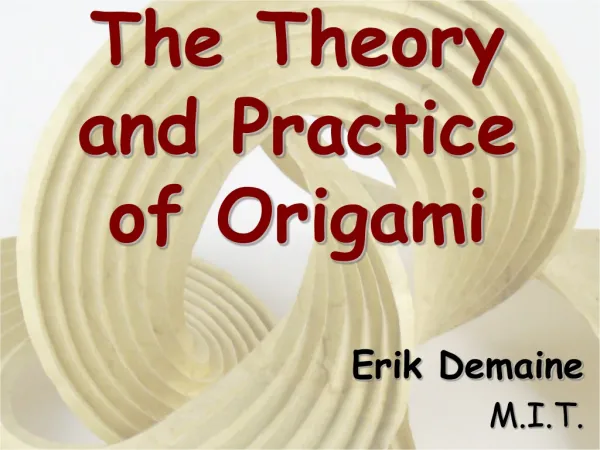
The Theory and Practiceof Origami Erik Demaine M.I.T.
Origami • Perhaps as old as paper itself (105 AD) • Revolution in complexorigami design overpast ~25 years Satoshi Kamiya Satoshi Kamiya
Origami USAConvention2009 Brian Chan Joel Cooper Goran Konjevod
Folding Anything (in Theory) [Demaine, Demaine, Mitchell 1999] • Theorem: Any 2D or 3D shapecan be folded from a square of paper
Tree Method of Origami Design [Fujimoto, Kamiya, Kawahata, Lang, Maekawa, Meguro, Yoshino] [Lang, Demaine, Demaine 2006–2008]
Origamizer[Tachi 2006; Demaine & Tachi 2009] TomohiroTachi • Algorithm to fold any polyhedral surface Tomohiro Tachi
“Self-Folding” Origami “hyperbolic paraboloid”
Kenny Thermal origami[Cheung 2008]
Metal Folding Metal folding Demaine, Demaine,Tachi, 2008
Hinged Dissection[first used by Kelland 1864] • Fold polygons at cornersinstead of lines [Dudeney 1902]
Hinged Dissection Universality[Abbott, Abel, Charlton, Demaine, Demaine, Kominers 2008] • Theorem: For any finite setof polygons of equal area, there is a hinged dissection that can fold into any of the polygons,continuouslywithout self-intersection • Generalizes to 3D
Right-Angle Tetrahedra[Millibiology project: MIT, Harvard, Makani]
ribosome ProteinFolding
The Theory and Practiceof Origami Erik Demaine M.I.T.