Download
1 / 31
310 likes | 450 Views
Explore the dynamics of ecosystems and biomes, focusing on energy flow and nutrient cycles. This overview highlights the roles of producers, consumers (herbivores, carnivores, omnivores), and decomposers in food webs. Discover the intricacies of the water, carbon, and nitrogen cycles, and learn about biogeography and dispersal barriers that affect organisms. From biomes like forests and deserts to aquatic systems, this guide provides insights into how life forms adapt and thrive in various environments.

E N D
Ecosystems and Biomes Energy Flow in Ecosystems
Where do you get your food? • Producers – an organism that can make its own food by using the sun • Examples: plants, algae, bacteria • Consumers – an organism that feeds on other organisms; they cannot make their own food
What do you eat? • Herbivores – eat plants • Example – deer, horses • Carnivores – eat animals • Example – lion, bobcats • Omnivores – eat plants and animals • Example – humans, raccoons, dogs • Scavenger – feed on dead bodies • Example – crow, vulture
Where does it all go? • Decomposer – break down wastes and dead organisms and return the raw materials to the ecosystem • Examples – mushrooms, bacteria
So…what eats what? • Food Chain – series of events in which an organism eats another and obtains energy • Food Web – consists of many overlapping food chains in a system (organism has many roles)
ENERGY! • Energy Pyramid – shows the amount of energy that moves from one feeding level to another another • The most energy is available at the producer level of the pyramid
Ecosystems and Biomes Cycles of Matter
The Water Cycle • A never ending process by which water moves from Earth’s surface to the atmosphere and back (ice, liquid, gas)
The Water Cycle • Evaporation – the sun’s heat evaporates water • Liquid to gas • Condensation – clouds • Gas to liquid • Precipitation – small drops of water larger drops of water • Rain, snow, hail, sleet
Carbon and Oxygen Cycle • All living things are made up of carbon • Most organisms use O2 in their life processes • Producers – take in CO2 • Consumers – release CO2 • Producers – release O2 • Consumers – take O2 in
The Nitrogen Cycle • Nitrogen – necessary building block • Consumers – eat substances that have nitrogen • Decomposers – break down dead organisms and wastes
The Nitrogen Cycle • Nitrogen Fixation – changing nitrogen into a usable form • Bacteria found in (roots) • Clover • Beans • Peas • Alfalfa • peanuts Legumes
Ecosystems and Biomes Biogeography
The Theories • Biogeography – the study of where organisms live • Continental Drift Theory (Pangaea Theory) • When the continents move because of the movements of plates • 225 million years ago it was one big land mass called Pangaea
But…How? • Dispersal – ways in which organisms can move from one area to another • Wind, water, other organisms • Exotic species – organisms that are new to an area
Again, How? • Physical Barriers of Dispersal – mountains, deserts, bodies of water • Competition as a Barrier of Dispersal – if an organism goes to an area with too much competition, they will have a hard time finding a niche • Climate as a Barrier of Dispersal – too hot/ too cold, too dry/ too wet • the organism will not succeed in that area
Ecosystems and Biomes Biomes and Aquatic Ecosystems
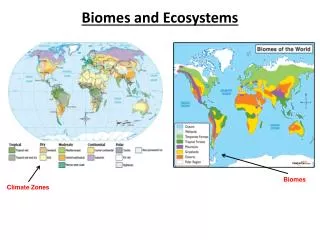
Biomes • Biome – a group of land ecosystems with similar climates and organisms. • Determined by their climate and precipitation
Biomes Temperate Rain Forest • Lot of rain • Located on the Northwestern coast of the U.S. • Moderate temperatures (medium)
Biomes Tropical Rain Forest • Lots of rain • High temperatures • Canopy – tops of the tall trees • Understory – shorter trees and vines • More plants and animals than all other biomes combined
Biomes Desert • Little or no rain • Very hot • Rate of evaporation > precipitation • Colder at night – nocturnal animals
Biomes Grassland • Hot temperatures • Some rainfall, not enough rain to help trees grow • Lots of tall grass • Savanna – more rainfall than a prairie, low shrubs and trees • Largest animals – lions, buffaloes, cheetahs
Biomes Deciduous Forest • Moderate temperatures • Good amount of rain • Lots of summer animals, but they hibernate or migrate in the winter • We live in this biome - NY
Biomes Boreal Forest (Taiga) • Spruce – moose biome • Colder temperatures • Lots of snow • Pines, spruce (needles store water) • Lynx, moose, fox, beavers • NY is in this biome also
Biomes Tundra Biome • Extremely cold and very dry (no rain and not a lot of snow) • Permafrost – frozen soil (not a lot of plants) • Permafrost and moss • Caribou, wolves, arctic foxes, arctic hares
Biomes Arctic • Massive amounts of ice • Tops of mountains and glaciers • Greenland, Antarctica • No plants, no soil • Emperor penguins, polar bears
Freshwater Ecosystems • Only a tiny fraction is covered by freshwater Streams and Rivers • Water is flowing in one direction • Streams typically lead to rivers • Not a lot of algae Ponds and Lakes • Water stays still • Lots of algae
Marine Ecosystems Estuary • Where the freshwater of a river meets the saltwater of an ocean • Calm waters are located here, so it’s a prime spot for breeding
Marine Ecosystems Intertidal Zone (ITZ) • Line between high-tide and low-tide lines • Barnacles, sea stars, crabs Neritic Zone • Shallow area that extends out over the continental shelf • Lots of light penetrates this area • Lots of plants, coral, fish, sharks
Marine Ecosystems Open Ocean Zone • Out past the neritic zone • Only the surface gets light • Phytoplankton • Whales, squid, deep sea angler fish