Aversive Odor Reduces Tyrosine Decarboxylase Expression in Blowfly Olfactory Neurons
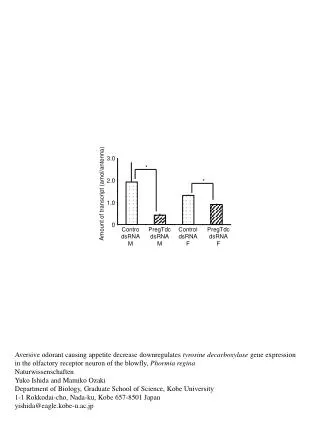
This study investigates how an aversive odor affects the expression of the tyrosine decarboxylase gene in the olfactory receptor neurons of the blowfly, Phormia regina. Understanding the mechanisms by which negative stimuli can influence gene expression in sensory neurons may provide insights into the neurobiological processes associated with appetite regulation. The research was conducted by Yuko Ishida and Mamiko Ozaki at the Department of Biology, Kobe University, Japan.

Aversive Odor Reduces Tyrosine Decarboxylase Expression in Blowfly Olfactory Neurons
E N D
Presentation Transcript
3.0 * * 2.0 Amount of transcript (amol/antenna) 1.0 0 Contro dsRNA M PregTdc dsRNA M Control dsRNA F PregTdc dsRNA F Aversive odorant causing appetite decrease downregulates tyrosine decarboxylase gene expression in the olfactory receptor neuron of the blowfly, Phormia regina Naturwissenschaften Yuko Ishida and Mamiko Ozaki Department of Biology, Graduate School of Science, Kobe University 1-1 Rokkodai-cho, Nada-ku, Kobe 657-8501 Japan yishida@eagle.kobe-u.ac.jp