Download
1 / 19
190 likes | 316 Views
R.D. Viollier University of Cape Town. Neutrino Masses Dark Matter and the Mysterious Early Quasars. The Mysterious Early Quasars.

E N D
R.D. Viollier University of Cape Town Neutrino Masses Dark Matter and the Mysterious Early Quasars
The Mysterious Early Quasars • Observational facts: Earliest quasar SDSS J114816.64 +525 150.3 has redshift z = 6.42 corresponding to receding velocity v/c = 0.96. Quasar light was emitted at te= 0.85 Gyr and is observed today at to= 13.7 Gyr after the Big Bang (WMAP-3). • Simplest interpretation: Quasar is temporarily (Δt < 30 Myr) powered by isotropic accretion of baryonic matter onto a supermassive black hole of mass M = 3×10⁹ M☼, radiating at the Eddington luminosity
The Eddington Luminosity • gravitational force on protons dominates • radiational force on electrons dominates M(r) - mass enclosed within r mp - proton mass LE(r) - nett luminosity crossing r outwards σT - Thomson cross section of the electron
The Eddington Luminosity cont. • local neutrality of plasma implies Fgrav(r) = Frad(r) or Eddington luminosity
Black Hole Mass Increase • differential equation εM = 0.1 is the standard efficiency εL = L/LE = 1 for the Eddington limit mass doubling time Eddington time characteristic time • solution • Answer: • 210 ~ 103 230 ~ 109 • 30 mass doubling times • t = 30 × 35 Myr = 1.05 Gyr
Simplest Scenario for the formation of supermassive black holes HOWEVER: • the massive star can only form after zreion~ 11 or treion ~ 0.365 Gyr • reionization molecular hydrogen • Compare this tform> 1.437 Gyr to the observed times of te ~ 0.85 Gyr • this scenario does not work!
Three possible remedies • initial BH mass should be MBH(0) = 1.4×10⁵ M☼ instead of MBH(0) = 3M☼ population III stars? • allowing super-Eddington accretion with e.g. εL = 2 instead of εL = 1 non-spherical accretion? • lowering the efficiency from εM = 0.1 to εM = 0.05 (dark matter has εM = 0!) X X √
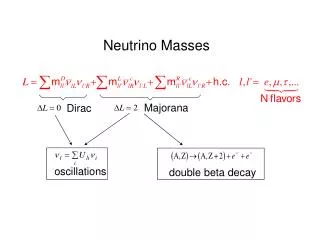
ν-Minimal Extension of the Standard Model • P. Minkowski, Phys. Lett. B67 (1977) 421: add 3 right-handed (or sterile) neutrinos invention of the seesaw mechanism renormalizable Lagrangean which generates Dirac and Majorana masses for all neutrinos LSM: Lagrangean of the Standard Model Φi = εijΦj*: Higgs doublet Lα (α=e,μ,τ): lepton doublet NI (I=1,2,3): sterile neutrino singlet kinetic energy terms Yukawa coupling terms MD = FαI‹Ф›exp ~ Majorana mass terms MI
Discussion of the νMSM • In comparison with the SM, the νMSM has 18 new parameters: • these parameters can be chosen such as to be consistent with the solar, atmospheric, reactor and accelerator neutrino experiments • the baryon asymmetry comes out correctly • the Majorana masses are below the weak interaction symmetry breaking scale • the lowest mass right-handed (or sterile) neutrino has a mass of O(10 keV) and is quasi-stable: it could be the dark matter particle
Spectrum of the νMSM quasi-stable dark matter particle, observable through its radioactive decay unstable, observable at accelerators M. Shaposhnikov arxiv: 0706.1894v1 [hep-ph] 13.06.2007
Properties of N1 ≡ νs • to fix our ideas, we assume that the lightest sterile neutrino νs has • production process: scattering of active neutrinos out of equilibrium • production process is necessarily linked with decay process! mixing: resonant or non-resonant ≡ vacuum L. Wolfenstein (1978)
Early Cosmology • νs’s produced at T ~ 328 (mc2/15 keV)1/3 MeV/K with Ωs= 0.24 through resonant and non-resonant scattering of active neutrinos • ~ 22 min after Big Bang, the νs’s are non-relativistic • νs’s dominate the expansion of the universe ~ 79 kyr after Big Bang • degenerate νs-balls form between 650 Myr and 840 Myr
Mass Limits of νs-balls • mass contained within the free-streaming length at matter-radiation equality at 79 kyr is • since part of the neutrinos may be ejected, the minimal mass that may collapse is perhaps Mmin ~ 106M☼ . • the maximal mass that a self-gravitating degenerate neutrino ball can support is the Oppenheimer-Volkoff limit resonant production, cold non-resonant production, warm Planck mass m-dependent
Symbiotic Scenario for the formation of supermassive black holes NEW M.C. Richter, G.B. Tupper, R.D. Viollier JCAP 0612 (2006) 015; astro-ph/0611552 NEW NEW antihierarchical formation of quasars and active galactic nuclei
Accretion of a Neutrino Halo onto a Black Hole • Bernoulli’s equation for a steady-state flow • the flow is trans-sonic, i.e. • Bernoulli’s equation is now • Here, v(x) fulfils the Lane-Emden equation • u(r): flow velocity of infalling degenerate sterile neutrino fluid • vF(r):Fermi velocity • φ(r):gravitational potential • rH:radius of the halo
Accretion continued Total mass enclosed within a radius r = bx is Solutions of the Lane-Emden equation with constant mass M = MC + MH= 2.714 M⊙
Accretion continued • mass accretion rate into a sphere, containing a mass MC within a radius rC from the centre is • with universal time scale • and shut-off parameter, defined as μ = MC /M rC = bxCis now the radius at which the escape velocity is c
Results M.C. Richter, G.B. Tupper, R.D. Viollier JCAP 0612 (2006) 015; astro-ph/0611552
Conclusions 4 main characteristics of the symbiotic scenario: • no Eddington limit for νs-ball formation and accretion onto BH • matter densities in νs-balls much larger than any form of baryonic matter of the same total mass • νs-balls have for m ~15 keV/c2 the same mass range as supermassive BH • different escape velocities from the center of the νs-balls may explain antihierarchical formation of quasars