Download
1 / 2
20 likes | 122 Views
The interaction of CO2, CH4, and temperature (ΔT) in the Vostok ice core data presents complex climate processes. Notably, the greenhouse effect suggests that changes in CO2 and CH4 levels influence temperature fluctuations. Additionally, the ocean's solubility effect indicates that temperature increases can lead to the ocean releasing CO2 into the atmosphere. Furthermore, the stability of methane clathrates is affected by temperature variations. Understanding these dynamic systems and their feedback loops is crucial for analyzing Earth's climate interactions.

E N D
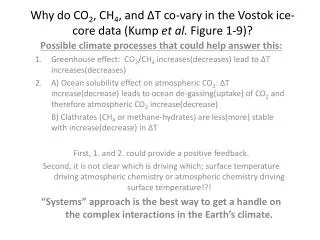
Why do CO2, CH4, and ΔT co-vary in the Vostok ice-core data (Kump et al. Figure 1-9)? Possible climate processes that could help answer this: Greenhouse effect: CO2/CH4 increases(decreases) lead to ΔT increases(decreases) A) Ocean solubility effect on atmospheric CO2: ΔT increase(decrease) leads to ocean de-gassing(uptake) of CO2 and therefore atmospheric CO2 increase(decrease) B) Clathrates (CH4 or methane-hydrates) are less(more) stable with increase(decrease) in ΔT First, 1. and 2. could provide a positive feedback. Second, it is not clear which is driving which; surface temperature driving atmospheric chemistry or atmospheric chemistry driving surface temperature!?! “Systems” approach is the best way to get a handle on the complex interactions in the Earth’s climate.
Terms and Terminology Dynamical Systems dynamical system – series of interacting components which are coupled system state – the complete set of attributes (state variables) that define the characteristics of the system at a particular moment in time coupling – physical process relating two state variables in a dynamical system positive coupling – the state variables are positively correlated. Example: greenhouse effect, where increases/decreases in one variable (CO2) lead to increases/decreases in another (temperature) negative coupling – the state variables are negatively correlated. Example: planetary albedo (or reflectivity), where increases/decreases in one variable (albedo or reflectivity) lead to decreases/increases in another (temperature) A systems diagram shows this information graphically – see Kump et al. Figures 2-1 and 2-2… feedback loop – self-perpetuating mechanism of change and a response to that change (better to understand the concept than memorize a definition!)