Acid Rain
This educational program, provided by the Maine Department of Environmental Protection, offers middle school students a comprehensive overview of acid rain. Students will learn about the chemistry behind acid rain, its natural and human-made sources, and its detrimental effects on ecosystems and human health. The program emphasizes the importance of air quality and environmental conservation, encourages proactive solutions to mitigate pollution, and outlines initiatives by the EPA to combat acid rain. Engage with interactive materials to foster a deeper understanding of environmental protection.

Acid Rain
E N D
Presentation Transcript
Acid Rain Environmental Education Middle School Program MAINE DEPARTMENT OF ENVIRONMENTAL PROTECTION Protecting Maine’s Air, Land and Water
Acid Rain Chemistry for All (5:36) MAINE DEPARTMENT OF ENVIRONMENTAL PROTECTION www.maine.gov/dep
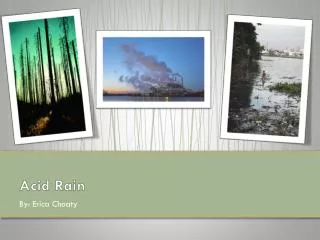
Acid Rain • Acid Rain forms when clean rain comes in contact with pollutants in the air. • Sulfur Dioxide (SO2) • Nitrogen Oxides (NOx) • Carbon Dioxide (CO2) MAINE DEPARTMENT OF ENVIRONMENTAL PROTECTION www.maine.gov/dep
Acid Versus Base • Acids and bases are classified on a pH scale. • Acid – any of a large group of chemicals with a pH of less than 7. • Base – any of a large group of chemicals with a pH greater than 7. • Neutral – any substance that is neither an acid or base; pH is 7.
Acid Precipitation • The interaction between falling water droplets and CO2 in the atmosphere gives rain a pH of 5.6. • Acid rain is considered a pH of 5.6 or less, not pH of 7.
Dry Deposition • About half of the acidity in the atmosphere is deposited onto buildings, cars, homes, and trees as particles and gases. • Dry deposition may be washed from trees and other surfaces by rainstorms. • This runoff water contains acid from the rain and dry deposits, making a more acidic combination than that of the acid rain alone. • The combination of acid rain plus dry deposition is called acid deposition.
Natural Sources of Acids • Volcanoes • Geysers • Hot Springs
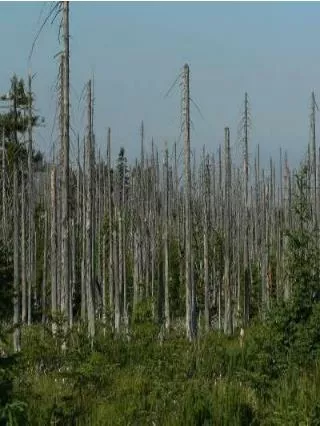
Effects on Ecosystems • Acid rain can damage organisms in an ecosystem. • This may cause a ripple effect harming the ecosystem. • This damage can take years or decades to reverse.
Acid Rain • On the forest floor • Buffering capacity of a soil depends on its makeup; some salts act as buffers, as does limestone.
Acid Rain • In ponds, lakes, and streams • Acid rain clearly effects aquatic environment. • Most lakes and streams have a pH between 6-8. • If the soils around the lakes and streams can’t buffer the pH the acid in the rains will affect the water. • Northeast U.S. has a lower buffering capacity, and pH values can be very low. ~pH of 5. • As pH values drop many plants and animals will not thrive.
Effects of Acid Rain on Humans • Acid rain looks, feels, and tastes like fresh clean water. • It is not dangerous to walk in acid rain or swim in slightly acidic water. • Breathing air that contains pollutants that cause acid rain can be hazardous to human health. • Most damage is done to the lungs and cause respiratory illnesses. • Visibility can be reduced by pollutants that cause acid rain.
Effects of Acid Rain on Man-Made Materials • Materials exposed to acid rain can be degraded. • Stone • Metal • Paint • All materials will degrade, but it happens faster when acid rain is falling.
What is Being Done? • The Environmental Protection Agency has worked for over 20 years to reduce the effects of acid rain. • The Acid Rain Program began as part of the 1990 Clean Air Act Amendments. • Persons from the EPA, States, Universities, and other agencies set up air quality and deposition monitoring. • NADP is one system to measure wet deposition and collect atmospheric data. • Continuous Emissions Monitoring Systems are used by power plants to track the amount of pollutants they release to the atmosphere.
…And What Can You Do? • Conserve electricity • Use the ENERGY STAR program • Use public/shared transportation • Reduce your carbon footprint