Understanding Sensation and Perception: Mechanisms, Theories, and Depth Perception
This presentation explores the intricate relationship between sensation and perception, outlining how sensation transforms into perception through perceptual processing. Key concepts such as feature detectors, perceptual constancies, and biases are discussed. Theoretical frameworks like Gestalt principles provide insights into how we organize stimuli into meaningful patterns. Additionally, the presentation examines depth perception, highlighting binocular and monocular cues that contribute to our three-dimensional understanding of the world. Join us in uncovering the complexities of how we interpret our sensory experiences.

Understanding Sensation and Perception: Mechanisms, Theories, and Depth Perception
E N D
Presentation Transcript
Perception By: Alyssa Beavers, Chris Gordon, Yelena Pham, Hannah Schulte
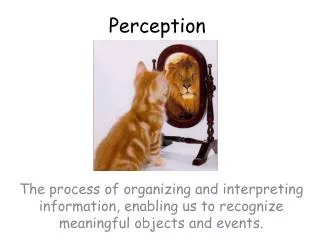
To start off… • What is the relationship between sensation and perception? • Perception: brings meaning to sensation; interpretation, NOT representation
Perceptual Processing • Process where sensation becomes perception • Feature detector: cells that detect specific stimulus • Ex. length, color, boundary • Even cells for only human features • Binding problem • Bottom-Up: perception is driven by stimulus • Top-Down: perception is driven by own mind • Person may have bias towards something • Perceptual Constancies: ability to recognize same object’s qualities under different conditions • Color, size, shape
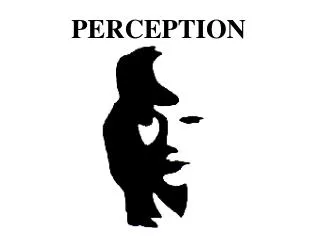
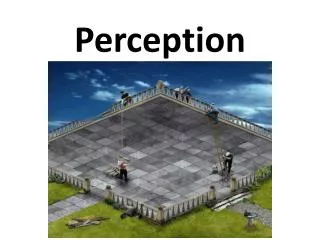
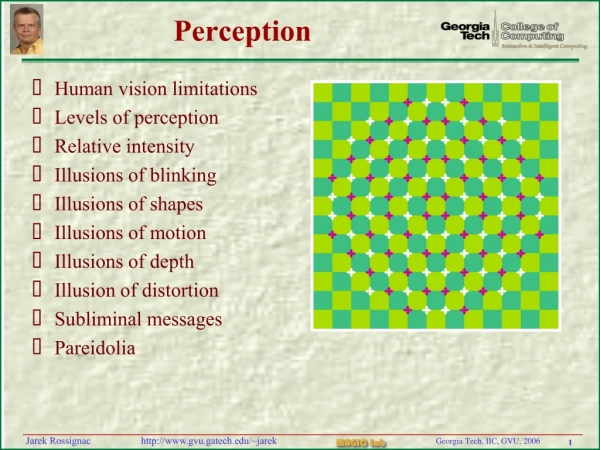
Ambiguity and Distortion • Illusion: incorrect perception of stimulus pattern • Ex. Hermann Grid, Muller-Lyer Illusion, dalmation • Ambiguous Figure: images with multiple interpretations; meant to perplex interpretations • Ex. Necker Cube, vase/faces • Artists, architects, interior designers, theatrical productions, clothes • Culture, context
Theoretical Explanations • Gestalt: Nature • Organize stimulation for meaningful patterns • See as whole rather than sum of parts • Learning-based Inference: Nurture • Influences on perception • Expectations, context, culture, etc. • Stroop Effect- demonstration of a reaction time of a task
Gestalt Theory • Figure and Ground: the main object of focus vs. a background • Closure: making assumptions to complete an incomplete figure • Grouping: preference to grouping stimuli together to have percept • Similarity, Proximity, Continuity, Common Fate
The Laws • Law of Similarity: similar objects • Law of Proximity: objects near each other • Law of Continuity: preference to perceive objects as connected rather than broken • Law of Common Fate: share a motion or destination
Depth Perception • Visual ability to perceive the world in three dimensions and distances of objects
Binocular Cues • Provides depth information when viewing a scene with both eyes • Retinal Disparity: comes from differences of perspective from each eye • Convergence: vision lines from eyes meets at different angles at different distances
Monocular Cues • Provides depth information when viewing a scene with one eye • Relative size, light and shadow, interposition, relative motion, atmospheric perspective • Accommodation: how the eye muscles change to focus on an object depending on distance • Linear Perspective (Ponzo Illusion): parallel lines appear to converge to portray depth/distance
Demonstration Time! • http://www.david.tam.name/SelfTests/StroopEffects.html • http://en.wikipedia.org/wiki/Rorschach_test
Bibliography • Depth perception (2012, October 7). Retrieved November 29, 2012, from http://en.wikipedia.org/wiki/Depth_perception • (n.d.). Retrieved November 29, 2012, from http://psych.hanover.edu/krantz/art/linear.html