Understanding and Graphing Linear Equations: A Guide to Slopes and Coordinate Planes
This guide covers the basics of linear equations, including their representation, characteristics, and how to graph them. A linear equation is defined as an equation with two variables, both to the first power, resulting in a straight-line graph on a coordinate plane. The guide explains ordered pairs, horizontal and vertical lines, and the concept of slope, which indicates the steepness of the line. Practical examples are provided to find ordered pairs and slopes, enabling learners to grasp these foundational concepts in algebra.

Understanding and Graphing Linear Equations: A Guide to Slopes and Coordinate Planes
E N D
Presentation Transcript
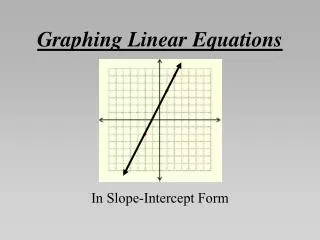
Graphing Linear Equations • Linear equation: an equation with two variables that are both to the first power. Ex. x + y = 3 • The graph of a linear equation will always be a straight line.
Previously, you’ve solved equations that contain just one variable. For example, let’s solve: 2x + 3 = 7
Linear equations have an infinite number of solutions. • When we solve a linear equation, we get a list of ordered pairs. • The graph of all of the ordered pairs creates a straight line.
Horizontal and Vertical Lines • Sometimes, the graph of an equation is a horizontal or a vertical line. • If our equation only contains a “y”, then our graph is a horizontal line. • If our equation only contains an “x”, then our graph is a vertical line.
Example y = 3
Example x = 3
Examples For each of the following linear equations: • Find four ordered pair that complete the equation • Plot the ordered pairs on a coordinate plane • x + y = 6 2) y = x + 1 3) x = 4
x + y = 6 Ordered Pairs
Y = x + 1 Ordered Pairs
x = 2 Ordered Pairs
Slope • Slope: A number which is used to indicate the steepness of a line, as well as indicating whether the line is tilted uphill or downhill. • Think of a road going uphill (or downhill). The steepness of the road is the slope.
The slope we are studying is associated with the graph of a line.
Vertical ChangeHorizontal Change This ratio is also known as Rise Run
Now that we have our line lets find its slope. Remember we are finding the following ratio: Vertical or Rise Horizontal Run
Vertical RiseHorizontal Run 3 4
The slope is… 1 2
The slope is… • Black line 3 • Red Line 1 • Blue Line -1/2
The slope is… • Orange line 0 • Green Line Undefined
Let’s go back to our first example. • Graph the line that goes through (3,2) and (-1,-1)
Equation (3,2) and (-1,-1)