Understanding the Evidence for Evolution: Vestigial and Homologous Structures
This piece explores key evidence supporting the theory of evolution, focusing on vestigial organs, homologous structures, and analogous structures. Vestigial organs serve no useful function and are remnants of evolutionary history, while homologous structures share a common embryonic origin but differ in form and function among species. The article also delves into analogous structures, which, despite arising in unrelated species, perform similar functions. Other supportive evidence includes biochemical DNA analysis, fossil records, geographic distribution of species, and embryological similarities, all illuminating the evolutionary process.


Understanding the Evidence for Evolution: Vestigial and Homologous Structures
E N D
Presentation Transcript
Evidence • Let’s examine a few categories that support the process of evolution
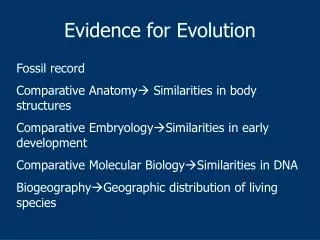
Vestigial Organ • An organ that serves no useful function in an organism • AKA “evolutionary leftovers”
Homologous Structure • Structures that have different mature forms in different organism but develop from the same embryonic tissues • In other words, they look different in adults but looked the same in embryos
Homologous Structure • Look back at the STATION #2 separate sheet
Analogous Structure • Similar structures found in dissimilar organisms • In other words, the organisms are not closely related, the structures evolved separately, but they turned out to look similar and serve a similar function
Analagous Structure • Let’s look at an example…
Biochemical • Analyzing DNA similarities between living and extinct organisms • Most reliable!!!
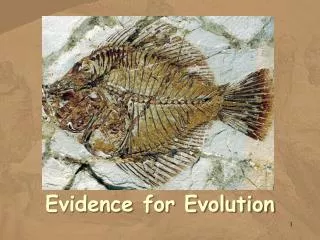
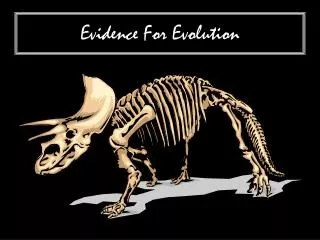
Fossil Record • Analyzing the fossil record to observe how species have changes from their extinct ancestors
Geographic Distribution • Species in a confined geographic area can evolve from a single ancestor • Species in different but similar locations can evolve similarly
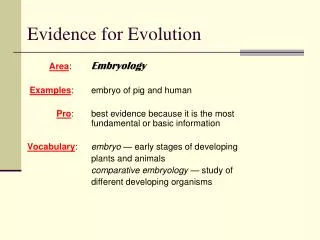
Embryology • Studying the similarities between different species as embryos • In other words, the similarities of development leads to the formation of homologous structures