Understanding Evolution: Evidence from Fossils, Biogeography, Anatomy, and Biochemistry
This comprehensive overview covers multiple lines of evidence supporting evolution. The fossil record showcases the remnants of early life and evolutionary transitions, such as the origins of whales from land mammals. Biogeography illustrates how organisms adapt similarly in comparable environments. Comparative anatomy highlights homologous structures with shared evolutionary origins, contrasting them with analogous structures that serve similar functions yet arise independently. Additionally, we explore embryology's insights into common ancestry and the role of biochemistry in unifying life through genetic links.

Understanding Evolution: Evidence from Fossils, Biogeography, Anatomy, and Biochemistry
E N D
Presentation Transcript
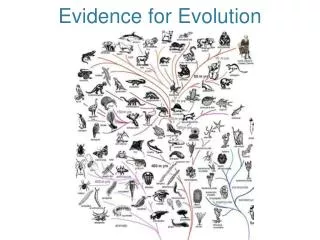
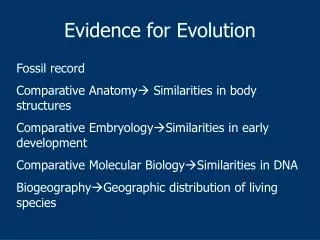
Evidence for Evolution • Fossil Record and Biogeography • Embryology • Body Structures (Anatomy) • Biochemistry
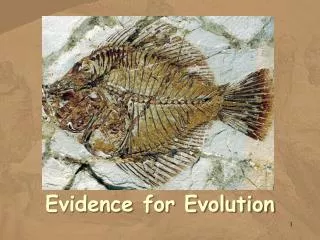
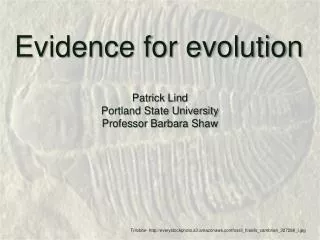
Fossil Record • Fossils are an important source of evolutionary evidence because they provide a record of early life and evolutionary history. • Ex. Whales descended from land-dwelling, doglike animals • Most of the fossil record is complete with intermediate forms (Figure 7 on page 382) • Fossils are found throughout the world
Biogeography • Biogeographyis the study of the locations of organisms around the world • Similar environments shape the evolution of organisms in similar ways
Anatomy • Homologous structures-structural features with a common evolutionary origin • They can be similar in arrangement, in function, or in both. • Figure 9 on page 384 shows the appendages of different organisms that have similar bones. The function of each appendage is different but the similar bone structure shows that the organisms came from a common ancestor.
Homologous Structures • Structural features with a common evolutionary origin • Same structure but different function
Analogous structures • Analogous structures-structures that are similar in function but do not have a common evolutionary origin • Ex. An insect and a bird both have wings to fly but the wings are made of different materials. An insect’s wing is made of chitin, a protein, whereas a bird’s wing is made of bone, flesh, and feathers. • There is no evolutionary tie between an insect and a bird and most likely adapted the ability to fly separately. • Same function but different structure.
Vestigial Structures • Vestigial structures-a body structure that has no function presently but was probably useful to an ancestor • Even though the species does not need the feature, the structure is still inherited through genetics. • Ex. Eyes on blind mole-rats, flightless wings on an ostrich, appendix/tonsils on humans
Embryology • An embryo is the earliest stage of growth and development of plants and animals • Most embryos look very similar and have tail and gill slits
Embryology • This suggests a common ancestor. • As the embryos grow, the differences between organisms can be seen • Guess the Embryo!
Biochemistry • DNA, RNA, and proteins have been used to link organisms together into groups (page 384) • This is the basis of the classification system of organisms