Understanding Edge Detection: Algorithms and Techniques
This document delves into edge detection in images, focusing on various factors that contribute to edge formation, such as surface normal and color discontinuities. It covers foundational concepts including gradients and their mathematical basis, the significance of edge strength, and practical implementations like the Sobel operator. The text explores the Hough Transform as an effective method for detecting lines in images and discusses its algorithm, including enhancements for better accuracy. The paper provides insight into extensions and optimizations for efficient edge detection.

Understanding Edge Detection: Algorithms and Techniques
E N D
Presentation Transcript
Edge Detection CSE P 576 Larry Zitnick (larryz@microsoft.com)
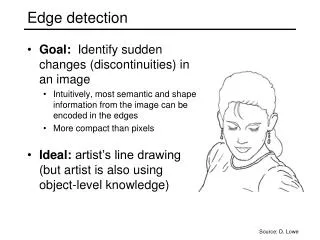
What is an edge? Cole et al. Siggraph 2008, results of 107 humans.
Origin of edges surface normal discontinuity depth discontinuity surface color discontinuity illumination discontinuity • Edges are caused by a variety of factors
Image gradient • The gradient of an image: • The gradient points in the direction of most rapid change in intensity
The gradient direction is given by: • How does this relate to the direction of the edge? • The edge strength is given by the gradient magnitude Image gradient How would you implement this as a filter?
Sobel operator In practice, it is common to use: Magnitude: Orientation:
Sobel operator Orientation Magnitude Original
Effects of noise • Consider a single row or column of the image • Plotting intensity as a function of position gives a signal Where is the edge?
Look for peaks in Solution: smooth first Where is the edge?
Non-maximum suppression • Check if pixel is local maximum along gradient direction • requires checking interpolated pixels p and r
original Canny with Canny with • The choice of depends on desired behavior • large detects large scale edges • small detects fine features Effect of (Gaussian kernel spread/size)
An edge is not a line... How can we detect lines ?
Finding lines in an image • Option 1: • Search for the line at every possible position/orientation • What is the cost of this operation? • Option 2: • Use a voting scheme: Hough transform
Finding lines in an image y b • Connection between image (x,y) and Hough (m,b) spaces • A line in the image corresponds to a point in Hough space • To go from image space to Hough space: • given a set of points (x,y), find all (m,b) such that y = mx + b b0 m0 x m image space Hough space
A: the solutions of b = -x0m + y0 • this is a line in Hough space Finding lines in an image y b • Connection between image (x,y) and Hough (m,b) spaces • A line in the image corresponds to a point in Hough space • To go from image space to Hough space: • given a set of points (x,y), find all (m,b) such that y = mx + b • What does a point (x0, y0) in the image space map to? y0 x0 x m image space Hough space
Hough transform algorithm • Typically use a different parameterization • d is the perpendicular distance from the line to the origin • is the angle • Why?
Hough transform algorithm • Basic Hough transform algorithm • Initialize H[d, ]=0 • for each edge point I[x,y] in the image for = 0 to 180 H[d, ] += 1 • Find the value(s) of (d, ) where H[d, ] is maximum • The detected line in the image is given by • What’s the running time (measured in # votes)?
Hough transform algorithm http://www.cs.utah.edu/~vpegorar/courses/cs7966/
Hough transform algorithm http://www.cs.utah.edu/~vpegorar/courses/cs7966/
Extensions • Extension 1: Use the image gradient • same • for each edge point I[x,y] in the image compute unique (d, ) based on image gradient at (x,y) H[d, ] += 1 • same • same • What’s the running time measured in votes? • Extension 2 • give more votes for stronger edges • Extension 3 • change the sampling of (d, ) to give more/less resolution • Extension 4 • The same procedure can be used with circles, squares, or any other shape