The Justification of Charles I's Execution and the Impact of the Glorious Revolution
This text explores the execution of King Charles I and debates its justification, linking it to the subsequent Glorious Revolution. Under the rule of William and Mary, England transformed from an absolute monarchy into a constitutional monarchy, ensuring that laws limited the sovereign's powers. The English Bill of Rights established essential principles, including parliamentary superiority and the protection of citizens' rights. The peaceful transition of power in 1688 laid the groundwork for a balanced relationship between the monarchy and Parliament in British governance.

The Justification of Charles I's Execution and the Impact of the Glorious Revolution
E N D
Presentation Transcript
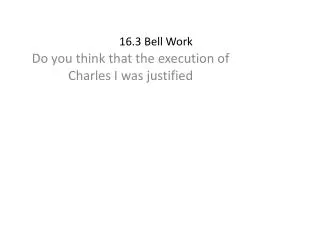
16.3 Bell Work Do you think that the execution of Charles I was justified
Section Four Glorious Revolution
William and Mary • Under their leadership, England was no longer an absolute monarchy, but a constitutional monarchy where laws limited the ruler’s powers. • English Bill of Rights= • No suspending of Parliament’s laws • No levying taxes without Parliament’s consent • No interfering with freedom of speech in Parliament • No penalty for a citizen who petitions the king about grievances • After 1688, no British monarch could rule without the consent of the Parliament and Parliament could not rule without consent of the monarch.
Glorious Revolution James’ daughter Mary and her husband William of Orange were chosen as successors. James could not win support and was fearful of being executed so he fled to France. William and Mary served as joint rulers of England in a peaceful coup. The Whigs and Tories wanted James to abdicate the throne.
Section Review Questions page 408 2-5 I learned …………