Active Galaxies
Active galaxies are characterized by high-energy emissions beyond standard stellar outputs. When galaxies emit substantial radiation in infrared, radio, UV, and X-ray wavelengths, they are classified as active. Key discoveries like quasars, initially identified by Maarten Schmidt, highlight this phenomenon. These galaxies’ supermassive black holes drive their activity, influencing star formation across the universe. Additionally, evidence of dark galaxies and hypervelocity stars contributes to our understanding of galaxy evolution and the intricate dynamics within these vibrant cosmic entities.


Active Galaxies
E N D
Presentation Transcript
Active Galaxies A Short Survey
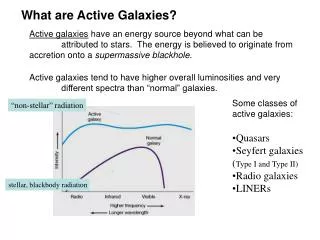
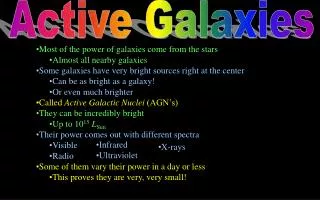
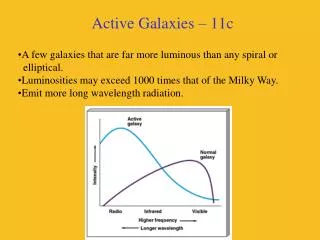
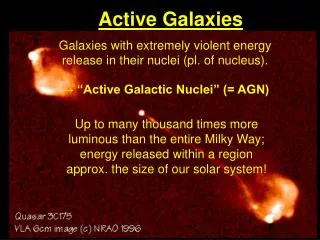
All Galaxies are active to some extent: • For "normal" galaxies, we can think of the total energy output as the sum of stellar emissions • However, Astronomers label a galaxy as active when it emits high energy radiation (infrared, radio, UV, and X-ray) beyond what the stars alone produce
Quasar Discovery • Maarten Schimdt examined 3S 273 • Exceedingly bright and small • Small as in quasi-stellar size • Outshined its galaxy therefore it seemed alone • Z = 0.16 (see next slide) • 2 Gyr away • Sloan DSS and 2o Field Galaxy Survey have found over 1 million • Their emission spectra was distinguished for galactic stellar absorption spectra • Now all are seen to be embedded in a galaxy
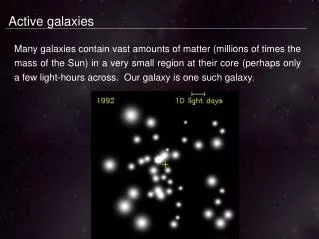
General Properties • Active galaxies are seen throughout time, but the peak period for quasars is at redshift z=2, about 9 Gyr ago, corresponding to a time when star formation was also peaking • A coincidence? Yes, star formation is now decreasing! • About 1–12 light months in size but with the energy of 100s of galaxies
End of an era… • The Milky Way is about 3% gas and 97% stars, not including dark matter • When this 3% is used up, even though supernovae and planetary nebula will return a small fraction to the interstellar medium, star formation will pretty much be over • Unless Smith’s cloud replenishes our galaxy • A huge cloud of hydrogen gas, is heading toward our Milky Way Galaxy at 250 kilometers per second
This shows the rate of star formation as a function of time • Mass of stars per Earth Volume is a proxy for rate David Sobral (Leiden Observatory)
Formation • The early Universe was smaller; dark matter caused greater clumping of stellar material • Likely low-mass (not so super) MBHs (1000Msun) merged into SMBH • Perhaps like in globular cluster W Centauri with a MBH of 40k Msun • M15 may have a wussy MBH of 1700 Msun
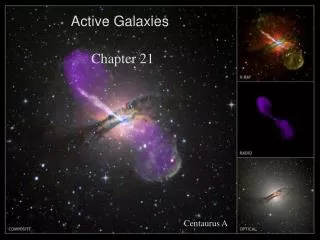
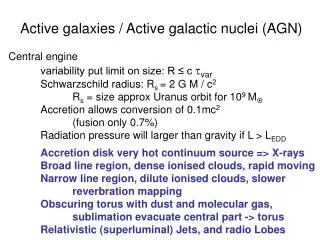
Driving Force • The powerplant for all the activity is the supermassive black hole in the nucleus of each galaxy • This mass of the SMBH can be from a million to 10 billion solar masses
Consistent Mass • As can be seen from the graph, there is a relationship between the mass of the SMBH and the rotation speed of the galaxy’s stars • Always ~ 0.2% of nuclear bulge
Accretion • Gas and occasionally entire stars form a disk around the SMBH, swirling around, waiting to fall in. • The gravitational energy given up by infalling matter produces the radiant energy
Accretion disk for NGC4261 • 21cm line from VLBA (right) • HI absorption
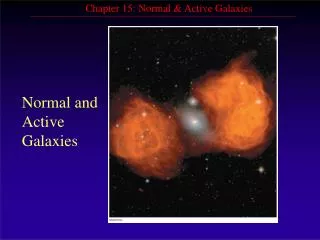
Radiant Energy • Dropping matter into a SMBH turns out to be ten times more efficient than fusion • Active galaxies can emit as much light a 1014 suns! • They do this in a region too small to be seen by most telescopes, ~ 1 parsec • A jet along galactic north and south 1030kg X 1017 (mc2) X 10% = 1046 J = 1053 ergs (a Type II SN every year (or more!))
Galaxy Cygnus A Jet v = 95%c for hundreds of Kpc
Driving Star Formation The quasar’s intense wind blew proto-stellar material out into the disk regions and provided the shock wave for star formation Artist’s Rendering HE0450-2958
Evidence of “Inside-Out” • Dark galaxies detected by VLT • Small, gas-rich galaxies in the early Universe • Inefficient star formation by themselves Dark galaxy illuminated by quasar
Hypervelocity Stars • Stars that have been so accelerated by the SMBH that they are shot out of the galaxy • Usually 1 of a binary pair • 1 falls into a tighter orbit, the other gains enough momentum and energy to escape • Speed: 1.6 million miles per hour • Here to Mars in 2 days! • An HV star has been observed escaping from the Large Magellanic Cloud, implying it has a SMBH
A Variety • All AGN are fundamentally the same, just seen from different angles and at different stages of its life • Quasar: Quasi-stellar Radio Source • Blazer • Quasar seen from the “top” • Massive synchrotron radio emissions (radio loud) • Like a Quasar but much more variable • Seyfert Galaxy • First identified 1943 (Carl Seyfert) • Radio quiet, strong IR, UV, and X-ray • Many other kinds that we must regretfully skip
Seyferts • Unusually bright nucleus • Unusual spectrum indicated high speed gas emission NGC4151
Blazar • Highest energy • Like a Seyfert with one jet pointed towards Earth • Variable output • +/- 10X a Quasar • Probably due to an uneven flow of material into the SMBH • Widest range of frequencies, radio to Gamma ray
Why so few nearby (now)? • As low-mass ‘seed’ SMBH coalesced in high-mass ones, they blew material (numnum) away, starving themselves • Also blew enough proto-stellar material away so that new stars in the core are rare, only Type II are found in abundance
Likely all galaxies had a quasar phase • Over time they settle down
For Us… • Active galaxies give a good, if skewed view of the early Universe • A clue, perhaps, that SMBH formed early on • Bottom up vs top down • That stars formed before galaxies • That early galaxies has an abundance of cold gas • That the SMBH was instrumental in widespread star formation