Download
1 / 4
40 likes | 157 Views
This comprehensive overview covers the key components of classic strategic management. It includes the formulation of a firm’s mission, elaboration on goals aligned with that mission, and the evaluation of both the competitive environment and internal resources. By implementing systems analysis, firms can assess inputs, processes, outputs, and feedback. Special attention is given to environmental scanning, generic strategy alternatives, and Michael Porter's Five Forces model. Additionally, it discusses co-opetitive strategic management for enhancing sales growth and market share through cooperative strategies.

E N D
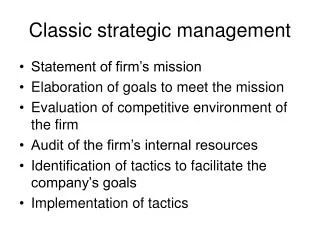
Classic strategic management • Statement of firm’s mission • Elaboration of goals to meet the mission • Evaluation of competitive environment of the firm • Audit of the firm’s internal resources • Identification of tactics to facilitate the company’s goals • Implementation of tactics
Systems Analysis • Looks at inputs, process, outputs, feedback • Mission and goals • Environment scanning • All key variables—competitor behavior, demographics, regulatory transitions • Industry and global assessment • Internal assessment • Generic strategy alternatives • Strategic variations—isolate most desirable options • Strategic choice • Resources and structure—systematic evaluation of all internal resources that can be exploited to support strategic plan • Implementation • Evaluation and control
Five-force model • Michael Porter’s plan for strategic management and planning • Degree of industry rivalry • Threat of entry • Threat of substitutes • Buyer power • Supplier power
Co-opetitive Strategic Management • Maximize firm’s sales growth, profitability, productivity, cost containment, and market share through cooperation instead of competition through • Business affiliations (mutual promotional agreements) • Alliances (cooperative nonequity agreements) • Partnerships (equity co-ventures) • Complementor versus competitor