Download
1 / 10
100 likes | 214 Views
This resource explains the concept of osmosis and its effects on water distribution in various solutions. When comparing a container of pure water and one of salt water, it explores why more water is found in the pure water container. The description includes factors affecting osmosis such as solute concentration on either side of a membrane. It provides links to animations illustrating the osmosis process and discusses cellular osmotic environments, detailing the movement of water based on solute concentration differences.

E N D
Answer the following: • You have two containers, one containing 100ml of pure water and 100 ml of salt water? In which container do you have more water? Explain • You have more water in the 100 ml of pure water because some of the volume of the 100ml of salt water is taken up by the NaCl and not all H20
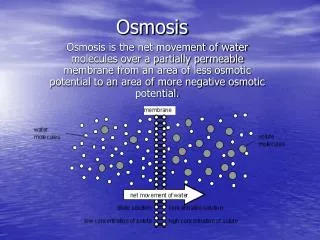
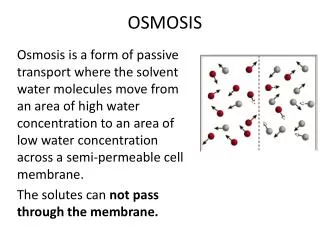
Osmosis: Diffusion of water through the membrane Factors that determine how the water will move across the membrane: Amount of solute inside the membrane Amount of solute outside the membrane
Is there an equal amount of water on both sides of the membrane? Higher amount of solutes outside the cell Lower amount of solutes inside the cell
View the animation • http://people.eku.edu/ritchisong/RITCHISO/osmosis3.gif • http://highered.mcgraw-hill.com/sites/0072495855/student_view0/chapter2/animation__how_osmosis_works.html
Three Cell Osmotic Environments Equal solutes on both sides of the membrane. Equal amounts of water on both sides of the membrane No net movement of water Less solute outside the membrane(more water) More solute inside the membrane(less water) Water will move IN to maintain water balance More solute outside the membrane(less water) Less solute inside the membrane(more water) Water will move OUT to maintain water balance
Let’s Watch Osmosis in Action • http://www.glencoe.com/sites/common_assets/science/virtual_labs/LS03/LS03.html
Osmosis Practice • Practice the osmosis questions