Download
1 / 17
170 likes | 290 Views
This content outlines essential concepts in biomedical image processing, including methods for image display, linear systems, and various imaging techniques such as optical microscopy, X-ray, magnetic resonance imaging (MRI), ultrasound, and electron microscopy. Key topics include pixel representation, greyscale and pseudo-colour display, contrast enhancement, and the impact of median filtering on image quality. Additionally, it covers machine detection principles, Rose's criterion, and the convolution integral within linear systems, providing a comprehensive overview for students and professionals in biomedical engineering.

E N D
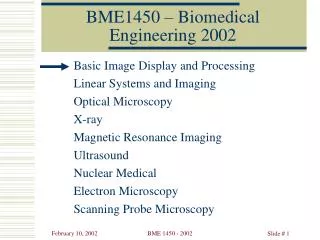
BME1450 – Biomedical Engineering 2002 Basic Image Display and Processing Linear Systems and Imaging Optical Microscopy X-ray Magnetic Resonance Imaging Ultrasound Nuclear Medical Electron Microscopy Scanning Probe Microscopy BME 1450 - 2002
Basic Image Display Greyscale • Measurements displayed as colors or shades of gray. • Pixels or voxels. • Axes unusual • Colour maps BME1450 - 2002
Basic Image DisplayPseudo Colour • Max 105 :white • Min 0 :black • (R, G, B) • Contrast • Histogram • 4x10⁴ :white • 2.5x10⁴ :black BME1450 - 2002
Basic Image DisplayContrast enhanced • Note colour bar range 2.5e4 to 4e4. • Higher contrast • More noise BME1450 - 2002
Basic Image DisplayMedian Filtered • Median Filter • Less spatial resolution BME1450 - 2002
Basic Image DisplayNoise • Find the disk objects. • 32x32 pixels • R = 3 pixels • 100 photons /pixels • + - 10 • Poisson BME1450 - 2002
Basic Image DisplayRose’s Criterion • Rose’s hypothesis is that the human will do as well as the best machine when both human and machine are given the same task and a priori information. • N equals sum of the pixels in the region where the disk may be. • The machine knows average N = NBG if the disk is present and NOB if it is absent. BME1450 - 2002
Basic Image DisplayMachine Detection • N equals sum of the pixels in the region where the disk may be. • The machine knows average N = NBG if the disk is present and NOB if it is absent. • The machine says "present" if N > (NOB + NBG)/2 and "absent" otherwise. • I chose cases for which the machine's probability of false positive is the same. BME1450 - 2002
Basic Image DisplayEqually Visible? • Now R = 7 pixels. • Disks have same visibility to the machine. • Their contrast is reduced. • Are they as easy to spot as the R=3? BME1450 - 2002
BME1450 – Biomedical Engineering 2002 Basic Image Display and Processing Linear Systems and Imaging Optical Microscopy X-ray Magnetic Resonance Imaging Ultrasound Nuclear Medical Electron Microscopy Scanning Probe Microscopy BME 1450 - 2002
Linear Systems and ImagingLinearity • Linear BME1450 - 2002
Linear Systems and ImagingSpatial Invariance • Spatially Invariant BME1450 - 2002
Linear Systems and ImagingConvolution Integral The convolution integral • h(x,y) is the “point response function” • It is the image of a delta function. • It is translated by (a,b), weighed by f(a,b) and added to g(x,y). BME1450 - 2002
Linear Systems and ImagingFourier Theory • Fourier Transform • Convolution Theorem • H is the transfer function of the system BME1450 - 2002
Fourier Domain = K Space BME1450 - 2002
Linear Systems and Imaging Effects of filtering Filter Width 32 pix In K space Of 256x256 BME1450 - 2002
Linear Systems and ImagingSpectral Components • Real part of the FFT of pixel Kx,Ky =3 • Other pixels 0 BME1450 - 2002