Understanding Covalent Bonding and Molecular Nomenclature in Chemistry
This resource covers key concepts of covalent bonding, including how covalent bonds form through shared valence electrons, types of bonds (single, double, triple), bond lengths, and bond energy. It explains the essentials of naming binary molecular compounds and acids, including the use of prefixes for atom quantity and the conversion of suffixes from –ate to –ic and –ite to –ous for oxyacids. Additionally, it provides guidance on writing chemical formulas and drawing Lewis structures for covalent compounds, with practical examples to enhance understanding.

Understanding Covalent Bonding and Molecular Nomenclature in Chemistry
E N D
Presentation Transcript
Covalent Bonding Ms. Keller WTHS Chemistry
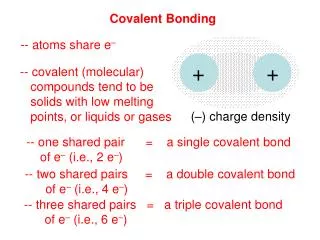
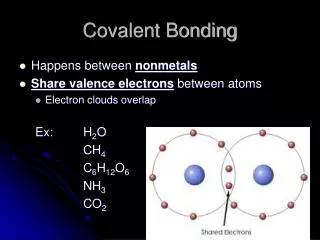
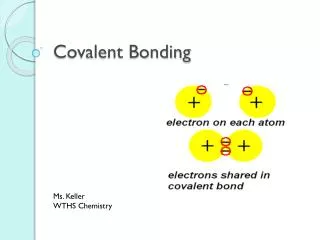
General Covalent-ness • Covalent bond- bond that results from the sharing of valence electrons Diatomic molecule: elements that are bonded to itself in nature Br I N Cl H O F
General Covalent stuff con’t • Types of bonds: • Single = sigma bond • Double = sigma bond + pi bond • Triple = sigma bond + 2 pi bonds Lone pair • Bonds are electron pairs that are being shared • Lone Pairs- unshared pairs of electrons
Bond Lengths • Bond Length-distance between the nuclei of the 2 atoms that are bonded when they are the most attracted to one another • Determined by: • Size of the atoms • How many electron pairs are shared (how many bonds there are) • As # of bonds , the bond length
Energy and Bonds • Bond dissociation energy- amount of energy needed to break a specific covalent bond • Breaking bonds ALWAYS requires the addition of energy • Endothermic vs. Exothermic
Naming Binary Molecular Compounds! • 1st element + 2nd element with the ending -ide • Use the following prefixes to indicate the number of the atoms of each element present: 1. mono 6. hexa 2. di 7. hepta 3. tri 8. octa 4. tetra 9. nona 5. penta 10. deca
Naming Acids! • Binary method: • 1. prefix = hydro (to represent hydrogen) • 2. root of 2nd element • Change ending to –ic acid • Ex) HF = hydrofluoric acid
Naming Acids! • Oxyacids: Acids that contain oxygen • Don’t put Hydro in for hydrogen! • If the group ends in –ate, it changes to –ic • If the group ends in –ite, it changes to –ous • ATE –IC, ITE –OUS • Throw acid on the end • Ex) H2SO4 = Sulfuric Acid • Ex) H2SO3 = Sulfurous Acid
Let’s Practice Naming… • C2O4 • NO2 • C4H10 • SO3 • N2O5 • HCl • HBr • H3PO4 • HClO2
Writing Formulas • Just read the name! • The prefix tells you how many of each element you have – this is your subscript! • Ex) carbon tetrafluoride = CF4 • Because tetra=4 and it’s attached to fluorine, it becomes the subscript
How to Draw Lewis Structures for Covalent Bonding • Add up all valence electrons • Add up all octets that need to be filled (octet=2 for H) • Subtract step 1 from step 2 • Divide value from step 3 by 2 to get how many bonds are in the molecule Ex) CH4
How to Draw Lewis Structures for Covalent Bonding Some hints for how they fit together: • Element closest to the left is usually the central atom • Hydrogen is always terminal (on the end)