Download
1 / 1
10 likes | 145 Views
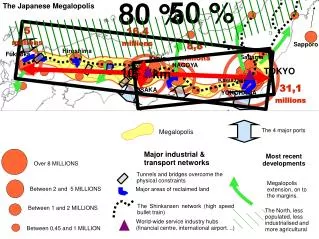
The Japanese Megalopolis spans 75 km, housing over 31 million residents, including major cities like Tokyo, Yokohama, and Osaka. This densely populated region features extensive industrial and transport networks, highlighted by the Shinkansen (bullet train) system. Innovative infrastructure, including tunnels and bridges, addresses physical constraints, while reclaimed land contributes to urban expansion. Recent developments reveal a thriving service industry and international hubs, fostering economic growth alongside the agricultural northern regions, which remain less populated.

E N D
50 % 80 % The Japanese Megalopolis 75 km 1000 km 5 millions 16,4 millions 8,8 millions Sapporo Hiroshima Fukuoka Saitama Kyoto NAGOYA Kobe TOKYO Kawazaki 31,1 millions OSAKA YOKOHAMA The 4 major ports Megalopolis Major industrial & transport networks Most recent developments Over 8 MILLIONS Tunnels and bridges overcome the physical constraints Megalopolis extension, on to the margins. Between 2 and 5 MILLIONS Major areas of reclaimed land The Shinkansen network (high speed bullet train) Between 1 and 2 MILLIONS The North, less populated, less industrialised and more agricultural World-wide service industry hubs (financial centre, international airport. ..) Between 0,45 and 1 MILLION