Download
1 / 12
120 likes | 222 Views
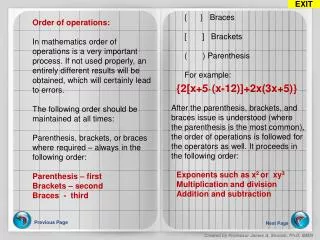
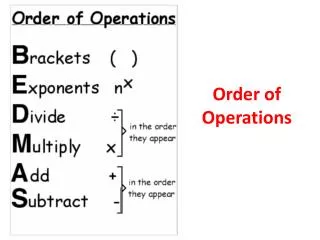
Understanding the order of operations is essential for accurately solving mathematical problems. Begin by reading the expressions carefully, focusing on grouping symbols such as parentheses (), brackets [], and braces {}. Execute calculations inside the grouping symbols first before proceeding to exponents, multiplication, and division, followed by addition and subtraction. Through practice, such as solving expressions like (2 + 3)² or complicated equations with multiple operations, you'll master this critical skill and enhance your mathematical proficiency.

E N D
Order of Operations Learn to Read the problem correctly Then there is no doubt The order of the process!
How do we read things in math • Parenthesis () brackets [] braces {} the quantity of example (4+6) is read the quantity of 4 plus 6. This means you must do the operation within the grouping symbol first – because you NEED the answer.
You try • (5 -3) • [ 4 + 17] • If multiple grouping symbols work from the inside out • {4+ [5 - (2 -1)] } • 2-1 = 1 then 5-1 5-1 = 4 • Finally 4 + 4 = 8
Exponents times itself ___ times 4³ 4 times itself 3 times 4 ∙4∙4 or 64 So if you have (2+3)² You would read it The quantity of 2 plus 3, times itself two times You would then know that you have to add 2 and 3 first, 5. You would then take that answer, 5, and multiply it by itself 2 times. 5 · 5 = 25
What would you do? 5³ (2+0)² (5-1)³ (10-4)¹
Multiplicationgroups of • 4 ∙ 3 is 4 groups of 3 when you read the math phrase this way, you know you must find out how many 4 groups of 3 is or in other words, what is 4 times 3 • You try • 7 6∙ 2 5 · 10
Divisionitems divided into groups of • 10÷2 10 items divided into groups of 2 • 25÷5 25 items divided into groups of 5 • 100÷10 • 1500÷500
Just like in English we would read left to right, processing things. Don’t forget to pay attention to the verbiage. Let’s try a few. Always copy all parts of the problems 2÷2 + 4 · 4 + 7 = 1 + 4 · 4 + 7 = 1 + 16 + 7 = 17 + 7 = 24
5 + 4² - 7 Reads 5 plus the square of 4 (or 4 times itself two times) minus 7 Now let’s work it. 5 + 4² - 7 = 5 + 16 -7 = 21 – 7 = 14
I have ten stamps and I have 4 groups of 3 stamps. How many stamps do I have? How do I write this mathematically? 10 + 4 ∙ 3 = 10 + 12 = 22
Sharon has 4 photo albums on her shelf. She put another 5 stacks of 4 photo albums on the shelf. How may photo albums were on the shelf? Let’s draw it first – to see what she has. Sharon’s 4 albums Photo albums 4 + 5 ∙ 4 =
Practice Work Instructions – rewrite the problem using words. Then write the original math problem. Work each step – showing all work - be careful to not drop any part of the problem. 7 + 3 ∙ 3 + (2+1) 90 ÷ (8 +2) 5 · 8 – 2· 4 45 + (2 +3)²