Download
1 / 9
90 likes | 253 Views
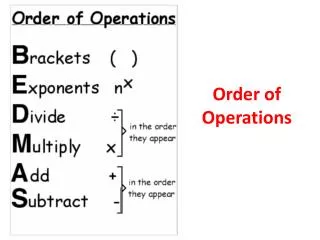
Understanding the order of operations is crucial in solving mathematical expressions. PEMDAS (Parentheses, Exponents, Multiplication and Division, Addition and Subtraction) provides a clear path. In this guide, we explore how to correctly approach expressions with brackets, braces, and parentheses. Learn the importance of performing operations in the right order, starting with the innermost parentheses and moving outward. We’ll go through practical examples to help solidify your understanding, ensuring you never stress over numerical expressions again!

E N D
Order of Operations PEMDAS DON’T STRESS
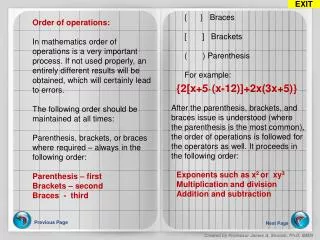
Numerical Expression: A mathematical phrase that includes numerals and operational symbols. It does not have an equal sign. Brackets: [[[[A pair of symbols used to group things together.]]]] Braces: The outer most grouping symbol used in mathematics. Parentheses: The symbols “(“ and “)” that are generally used for grouping. Operation: A mathematical process applied to solve a problem. Addition, subtraction, multiplication, and division are the four basic operations.
5 ( 3 ) • hint: numbers outside of parentheses should be multiplied by the inside value.
4 (7 – 2 ) • hint: complete operations inside of parentheses first.
11 ( 2 + 2 x 5 ) • hint: inside the parentheses, follow the order of operations; multiply before you add.
20 ÷ 5 – 1 x 3 • hint: when you have multiplication and division, work left to right.
10 ( 2 + 4 ) ( 14 ÷ 7 ) • hint: remember to complete parentheses first and move left to right.