Download
1 / 15
170 likes | 341 Views
This guide provides a comprehensive overview of antiderivatives, including their definition and key properties. An antiderivative F(x) of a function f(x) satisfies the condition F′(x) = f(x). Learn through practical examples, such as finding the most general antiderivative of functions involving polynomials and trigonometric terms. The guide also explores the implications of the theorem stating that if F(x) is an antiderivative of f(x), then so is F(x) + C. Master the concepts of calculating antiderivatives and related functions with ease.

E N D
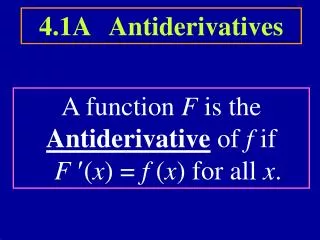
1. Definition: F(x) is an antiderivative of f(x) if F′(x)=f(x). 2. Example: f(x)=x3 +2x F1 (x)= F2 (x)= F (x)=
3. Theorem: If F(x) is an antiderivative of f(x), then so is F(x)+C.
Antiderivative xn+1 ———+C n+1 sin(x) -cos(x)+C cos(x) sin(x)+C sec2 (x) tan(x)+C sec (x)tan(x) sec(x)+C
Antiderivative Cx+D C Cf(x) CF(x) f(x)±g(x) F(x)±G(x) Ln |x|+C x-1 ex ex +C
Example 1: f(x)=sin(x)+x2. Find the most general antiderivativeof f. x 3 Solution: F(x)= -cos(x)+—+C 3 Check:
x 4 +x5 +2 f (x)= ————. Ex 2. Find the most x2 general antiderivative of f. Solution:
1 Example 3: If f′(x)=1+— x2 and f(1)=2. Find f(x). Solution: f(x)= f(1)= f(x)=
Example 4: f′(x)=4 - sec(x) tan(x) Find f′(x). f′(x)= sec(x)+ Solution: + = +sec(x)+ C
Example 5:f″(x)= x2 +3 sin(x), f(0)=2, f′(0)=3,. Find f(x). Solution: f′(x)= 3 cos(x) + C f′(x)= 3 3(1)+ f′(x)= 3 cos(x) + 6 f(x)= 3 sin(x)+
, f(1)=1, f(2)=0. Find f(x). Example 6: f″(x)= Solution: f′(x)= f(x)= f(1)= f(2)= 0 ....(2)
Subtract (2) from (1), we get Substitute into (2) for C1, we get
Subtract (2) from (1), we get Substitute into (2) for C2, we get f(x)=