Download
1 / 19
190 likes | 319 Views
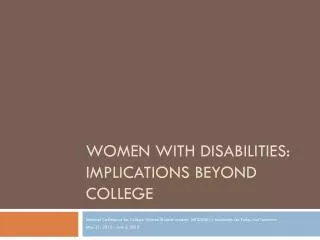
Women with Disabilities: Implications Beyond College. National Conference for College Women Student Leaders ( NCCWSL) – Leadership for Today and Tomorrow May 31, 2012 - June 2, 2012. Co-presenters. Susan McMenamin. Marcia Wiedefeld. Associate Director, Disability Support Services

E N D
Women with Disabilities:Implications Beyond College National Conference for College Women Student Leaders (NCCWSL) – Leadership for Today and Tomorrow May 31, 2012 - June 2, 2012
Co-presenters Susan McMenamin Marcia Wiedefeld Associate Director, Disability Support Services The George Washington University susanmcm@gwu.edu Director, Disability Support Services Loyola University Maryland mwiedefeld@loyola.edu
Co-presenters Alison Schiebelhut Martha Davis J.D., The George Washington University School of Law alisonschiebelhut@gmail.com Masters Candidate, Speech Pathology, Loyola University Maryland mwdavis@loyola.edu
Individuals with disabilities: The path to graduate studies • The effective implementation IDEA resulted in substantially more students gaining admissions to colleges and universities. • With the ADA and Section 504 of the Rehabilitation Act, many students are successful in college. • Our current economic/social climate has enhanced the significance of advanced degrees to future employment. • Students with disabilities are now also seeking opportunities for post-graduate and professional school study.
Laws promoting access for people with disabilities Education: • Individuals with Disabilities Education Act (IDEA) • Section 504 of the 1973 Rehabilitation Act • ADA • ADAAA Employment: • ADA • The Americans with Disabilities Act (and Amendments) ADAAA
College graduates who reported a disability (2007) National Center for Education Statistics U.S. Dept. of Education
Graduate students who reported a disability (2009) Council of Graduate Schools
Students with disabilities: Undergraduate and graduate fields
Number of doctoral degrees earned by individuals with disabilities (1997 – 2008)
Science and engineering: Employment of individuals with disabilities
Graduate or professional school: Application process, studies, and beyond • Graduate Exams (e.g., GRE, LSAT, GMAT, MCAT, etc.) • Undergraduate vs. Graduate • Different college… Different DSS office… Different procedures • Classroom vs. Clinical/Experiential Training Components • Licensure/Professional Exams
Transition to Work • Vocational Rehabilitation Services Individual state by state programs • Workforce Recruitment Program (WRP) • Career Opportunities for Students with Disabilities (COSD) • American Association of People with Disabilities (AAPD)
Transition to Work • Determining the impact of disability on job performance • To disclose or not to disclose – that is the question • Arranging for workplace accommodations – JAN • Other factors – social demands, etc.
Other Postsecondary Options • AmeriCorps • Peace Corps • Teach for America • Foreign Service
References American Association of People with Disabilities. http://www.aapd.com/ The American Diversity Program. 2011. Peace Corps: Standard Operating Procedure for Providing Reasonable Accommodation. http://multimedia.peacecorps.gov/multimedia/pdf/policies/Reasonable_Accommodation_Program_Policy_Revised_March_2011.pdf The American Psychological Association. 2012. DisABILITY Resources Toolbox (DART). http://www.apa.org/pi/disability/dart/index.aspx AmeriCorps. Purpose of the Disability Placement Award. http://www.americorps.gov/help/ac_admin_pdat/AdminPDATDisability_Provisions.htm#Purpose_of_the_Disability_Placement_Award.htm Career Opportunities for Students with Disabilities. http://www.cosdonline.org/home Education Testing Network. Disabilities and Health-related Needs. http://www.ets.org/disabilities
References Job Accommodation Network. www.askjan.org Law School Admission Council. Accommodated Testing. http://www.lsac.org/jd/lsat/accommodated-testing.asp The Legal Aid Society, Employment and Law Center. 2011. Your Legal Rights: Disabilities in Higher Education. Retrieved from: http://www.las-elc.org/factsheets/disabilities-education.html MBA.com: The Official GMAT Website. Register as a Test Taker with Disabilities. http://www.mba.com/the-gmat/schedule-a-gmat-appointment/register-as-a-test-taker-with-disabilities.aspx Medical College Admission Test. MCAT Exam with Accommodations. https://www.aamc.org/students/applying/mcat/accommodations/ National Center for Education Statistics (NCES). 2009. 2007-08. National Postsecondary Student Aid Study (NPSAS:08). Dataset.
References • National Science Foundation. 2010. Doctorate Recipients from U.S. Universities: 2009. Retrieved from www.nsf.gov/statistics/nsf11306/nsf11306.pdf • National Science Foundation. 2011. Women, Minorities, and Persons with Disabilities in Science and Engineering: 2011. Retrieved from www.nsf.gov/statistics/wmpd/ • Office for Civil Rights, U.S. Department of Education. 2011. Students with Disabilities Preparing for Postsecondary Education: Know Your Rights and Responsibilities. • http://www2.ed.gov/about/offices/list/ocr/transition.html • Teach for America. Admissions Policy. http://www.teachforamerica.org/why-teach-for-america/how-to-apply/applicant-prerequisites/admissions-policies • U.S. Department of Education. State Vocational Rehabilitation Programs. http://wdcrobcolp01.ed.gov/Programs/EROD/org_list.cfm?category_ID=SVR • Workforce Recruitment Program • https://wrp.gov/AboutPre.do