Download
1 / 13
130 likes | 270 Views
Electric fields arise from point charges and continuous charge distributions, exerting forces on charges within an external field. This guide discusses how to calculate electric fields generated by various charge configurations, including uniformly charged rods and semicircles. It outlines the steps to derive electric field expressions by integrating contributions from infinitesimal charge elements, employing coordinate systems, and choosing appropriate integration variables. Comprehend the principles governing electric fields and apply them to solve related problems.

E N D
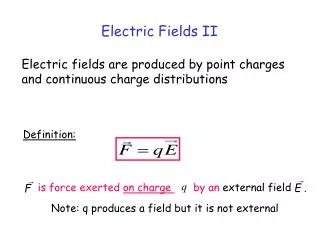
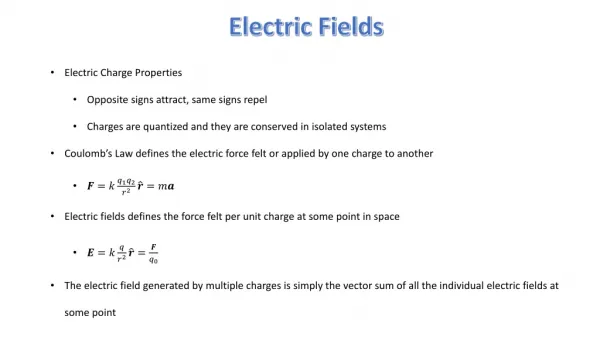
Definition: Electric Fields Electric fields are produced by point charges and continuous charge distributions is force exerted on charge by an external field Note: q produces a field but it is not external
dq + + + + + + + + + dE + + + Source Continuous Charge Distributions E = ? • Cut source into small (“infinitesimal”) charges dq • Each produces or
Steps: • Draw a coordinate system on the diagram • Choose an integration variable (e.g.,x) • Draw an infinitesimal element dx • Write r and any other variables in terms of x • Write dq in terms of dx • Put limits on the integral • Do the integral or look it up in tables.
L d Example: Uniformly-Charged Thin Rod (length L, total charge Q) + + + + + + + + + Charge/Length = “Linear Charge Density” = constant = Q/L
In 2D problems, integrate components separatelyto obtain the electric field: { x-component of
Example: Uniformly-Charged Ring y R x (x,0) Total charge Q, uniform charge/unit length, radius R Find: E at any point (x, 0)
y + + + + R x Quiz O Given the semi-circular uniform charge distribution, what would the direction of the electric field be at the origin, O?A) upB) downC) leftD) right
y R x Example: Uniformly-Charged Semicircle + + + + Charge/unit length, , is uniform Find: at origin
Summary • Field of several point charges qi: • Field of continuous charge distribution: