Bing Image Search
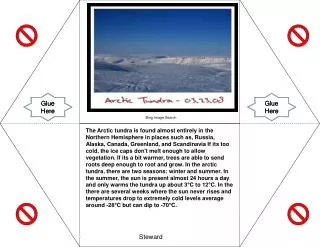
The Arctic tundra, predominantly located in the Northern Hemisphere across regions such as Russia, Alaska, Canada, Greenland, and Scandinavia, is a unique ecosystem characterized by extreme temperatures and limited vegetation. In this harsh climate, vegetation struggles to grow when ice caps prevent melting. The tundra experiences two distinct seasons: a brief summer with nearly 24 hours of sunlight, where temperatures hover between 3°C and 12°C, and a frigid winter with weeks of darkness, where temperatures can plummet to -70°C. Understanding this ecosystem is vital for wildlife and climate studies.

Bing Image Search
E N D
Presentation Transcript
Bing Image Search The Arctic tundra is found almost entirely in the Northern Hemisphere in places such as, Russia, Alaska, Canada, Greenland, and Scandinavia If its too cold, the ice caps don't melt enough to allow vegetation. If its a bit warmer, trees are able to send roots deep enough to root and grow. In the arctic tundra, there are two seasons: winter and summer. In the summer, the sun is present almost 24 hours a day and only warms the tundra up about 3°C to 12°C. In the there are several weeks where the sun never rises and temperatures drop to extremely cold levels average around -28°C but can dip to -70°C. Steward