Vision 2020: Future Directions in Earthquake Engineering Research
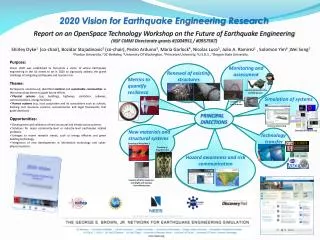
This report presents the outcomes of the Vision 2020 Workshop on Earthquake Engineering, which gathered experts to define the future of earthquake mitigation in the U.S. Participants emphasized the need to create resilient and sustainable communities, highlighting the importance of both physical systems (like infrastructure) and human systems (including socioeconomic frameworks). Key opportunities identified involve the development of innovative structural technologies, integration with information technology, and enhanced monitoring methods to quantify resilience against earthquake and tsunami risks.

Vision 2020: Future Directions in Earthquake Engineering Research
E N D
Presentation Transcript
2020 Vision for Earthquake Engineering Research Report on an OpenSpace Technology Workshop on the Future of Earthquake Engineering (NSF CMMI Directorate grants #1004951 / #0957567) Shirley Dyke1 (co-chair), Bozidar Stojadinovic2 (co-chair), Pedro Arduino3, Maria Garlock4, Nicolas Luco5, Julio A. Ramirez1 , Solomon Yim6 ,Wei Song1 1Purdue University, 2UC-Berkeley, 3University Of Washington, 4Princeton University, 5U.S.G.S., 6Oregon State University. • Purpose: • Vision 2020 was established to formulate a vision of where Earthquake engineering in the US needs to be in 2020 to vigorously address the grand challenge of mitigating earthquake and tsunami risk. • Theme: • Participants unanimously identified resilient and sustainable communities as the overarching theme to guide future efforts. • Physical systems (e.g. buildings, highways, sanitation, subways, communications, energy facilities) • Human systems (e.g. local population and its associations such as schools, banking and insurance systems; socioeconomic and legal frameworks that guide decisions) • Opportunities: • Development and validation of new structural and infrastructure systems. • Solutions for major community-level or industry-level earthquake related problems. • Linkages to recent research trends, such as energy efficient and green building technology. • Integration of new developments in information technology and cyber-physical systems. Monitoring and assessment Renewal of existing structures Metrics to quantify resilience Courtesy of Jennifer Riceand Bill Spencer Simulation of systems Courtesy of Luca Giacosa PRINCIPAL DIRECTIONS Courtesy of nees.org New materials and structural systems Courtesy of hubzero.org Technology transfer Courtesy of Hong-Nan Li Courtesy of Greg Deierlein Hazard awareness and risk communication Courtesy of Remy Lequesne, Jim Wight and Gustavo Parra-Montesinos