Exploring Graph Properties and Breadth-First Search Algorithm
This document delves into fundamental concepts of graph theory, including connectivity, cycles, and the effects of edge removal in directed and undirected graphs. It focuses on Breadth-First Search (BFS), a key algorithm for exploring vertices efficiently. BFS is used to find the shortest paths from a source vertex to all other vertices, and constructs a breadth-first tree. The performance of BFS is analyzed in terms of time complexity and its implications in graph traversal, aiding in various applications such as information retrieval on the World Wide Web.


Exploring Graph Properties and Breadth-First Search Algorithm
E N D
Presentation Transcript
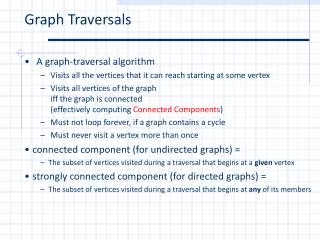
Is G connected? Is there a path from vertex a to vertex b? Does G have a cycle? Will removing a single edge disconnect G? If G is directed, what are the strongly connected components? If G is the WWW, follow links to locate information. Most graph algorithms need to examine or process each vertex and each edge. Graph Traversals Visit vertices of a graph G to determine some property:
the distance of each vertex from s. a tree of shortest paths called thebreadth-first tree. Breadth-First Search Find the shortest path from a source node s to all other nodes. Outputs Idea: Find nodes at distance 0, then at distance 1, then at distance 2, …
L = s 0 A BFS Example b s e c g f a d
L = s 0 L = a, c frontier of exploration 1 b s e c g f a d Visualized as many simultaneous explorations starting from s and spreading out independently.
L = s 0 L = d, e, f 2 b s e c g f a d Dashed edges were explored but had resulted in the discovery of no new vertices. L = a, c 1
L = s 0 L = d, e, f L = b, g 2 3 b s e c g f a d L = a, c 1
L = s 0 L = d, e, f L = b, g 3 2 The Finish b s e c g f a d L = a, c 1
b d(b): shortest distance from s to b s e c g f a d Breadth-First Tree 3 0 2 3 1 2 1 2 # visited vertices = 1 + # tree edges 1 + # explored edges.
The BFS Algorithm BFS(G, s) for eachv V(G) – sdo d(v) // shortest distance from s d(s) 0 // initialization L s T i 0 whileL ≠ do // all nodes at distance i from s L for eachu Ldo for eachv Adj(u) do ifd(v) = then // not yet visited d(v) d(u) + 1 insert v into L T T {(u, v)} i i + 1 0 i i+1 i i+1
Basis: L = s includes the only node at distance 0 from s. 0 Inductive step: Suppose L consists of all nodes at distance k≥ 0 from s. k k … s u v By hypothesis u L . Thus v L . k k+1 Correctness LemmaFor each i, the set L includes all nodes at distance i from s. i Proof By induction on the distance k from s. Every node v at distance k+1 from s must be adjacent to a node u at distance k. Corollary At the finish of BFS, d(v) is the length of the shortest path from s to v.
Every vertex is inserted at most once into some list L . i # edge scans u e ≤ |E| for a directed graph v ≤ 2 |E| for an undirected graph e v u 2 O(|V| )if represented as an adjacency matrix. Running Time O(|E|)if G is represented using adjacency lists. # inserted vertices 1 + # scanned edges |E| + 1. Courtesy of Dr. Fernandez-Baca