Download
1 / 2
20 likes | 120 Views
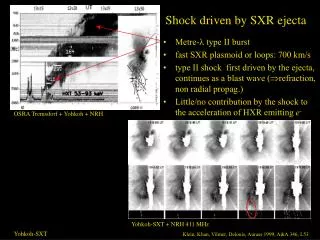
This study investigates a Type II solar X-ray (SXR) burst characterized by a shock driven by solar ejecta. Observations reveal fast SXR plasmoids and loops moving at speeds of 700 km/s. The analysis demonstrates that the Type II shock initially driven by the ejecta transitions into a blast wave with unique refraction and non-radial propagation characteristics. Notably, there is minimal influence from the shock on the acceleration of high-energy HXR-emitting electrons. This research integrates data from OSRA Tremsdorf, Yohkoh, and NRH observations.

E N D
Shock driven by SXR ejecta • Metre- type II burst • fast SXR plasmoid or loops: 700 km/s • type II shock first driven by the ejecta, continues as a blast wave (refraction, non radial propag.) • Little/no contribution by the shock to the acceleration of HXR emitting e- OSRA Tremsdorf + Yohkoh + NRH Yohkoh-SXT + NRH 411 MHz Yohkoh-SXT Klein, Khan, Vilmer, Delouis, Aurass 1999, A&A 346, L53