Understanding Spatial Thinking and the Five Themes of Geography
In this lesson, we will explore spatial thinking and the geographic patterns that shape our world. Students will learn about the Five Themes of Geography: Location, Place, Human-Environment Interaction, Movement, and Regions. By the end of the class, students will be able to identify three of these themes and take comprehensive notes. Activities include group work, discussions, and a worksheet focused on the geography of their school and neighborhood analysis. Engage in learning how to describe your surroundings through these essential geographic frameworks.

Understanding Spatial Thinking and the Five Themes of Geography
E N D
Presentation Transcript
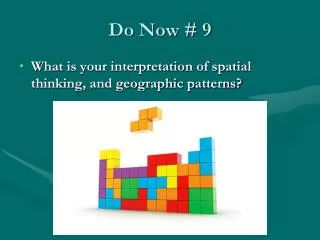
Do Now # 9 What is your interpretation of spatial thinking, and geographic patterns?
Agenda Do Now L.T/Lg.T Finish Group Activity Introduce Five Themes. HW
Learning/ Language Target L.T- By the end of class I will be able to identify 3 of the Five Themes of Geography. Lg.T- By the end of class I will also take notes on the Five Themes of Geography.
Spatial Thinking Finish Group Activity
THE FIVE THEMES OF GEOGRAPHY • Location • Place • Human-Environment Interaction • Movement • Regions
LOCATIONWhere are we? • Absolute Location • A latitude and longitude (global location) or a street address (local location). • Paris France is 48o North Latitude and 2o East Longitude. • The White House is located at 1600 Pennsylvania Ave. • Relative Location • Described by landmarks, time, direction or distance. From one place to another. • Go 1 mile west on main street and turn left for 1 block. You are Here
PLACE What is it like there, what kind of place is it? Physical Characteristics Landforms (mountains, rivers, etc.), climate, vegitation, wildlife, soil, etc. • Human Characteristics • What are the main languages, customs, and beliefs. • How many people live, work, and visit a place.
HUMAN-ENVIRONMENT INTERACTION • How do humans and the environment affect each other? • We depend on it. • People depend on the Tennessee River for water and transportation. • We modify it. • People modify our environment by heating and cooling buildings for comfort. • We adapt to it. • We adapt to the environment by wearing clothing suitable for summer (shorts) and winter (coats), rain and shine.
MOVEMENT • How are people, goods, ideas moved from place to place? • Human Movement • Trucks, Trains, Planes • Information Movement • Phones, computer (email), mail • Idea Movement • How do fads move from place to place? TV, Radio, Magazines
REGIONS • How are Regions similar to and different from other places? • Formal Regions • Regions defined by governmental or administrative boundaries (States, Countries, Cities) • Regions defined by similar characteristics (Corn Belt, Rocky Mountain region, Chinatown). • Functional Regions • Regions defined by a function (newspaper service area, cell phone coverage area).
Remembering the 5 themes • If you can’t remember what they are just ask MR. HELP!!! • M – Movement • R – Regions • HE – Human Environment interaction • L – Location • P - Place
Worksheet Complete the worksheet on the Geography of the School, and Match em up. You may work with a partner.
Your assignment • Describe your neighborhood using the Five Themes of Geography. • Make sure you use every theme!