The Sun
210 likes | 307 Views
Delve into the mysteries of our closest star, the Sun, and uncover its inner workings from the core to the atmosphere. Discover the intricate processes like nuclear fusion, explore the fascinating features like sunspots and solar flares, and learn about its destiny as it transforms over billions of years. Witness the beauty of a solar eclipse and the power of X-ray emissions. Journey through the lifespan of a star, from dwarf stars to supernovas and the enigmatic black holes.


The Sun
E N D
Presentation Transcript
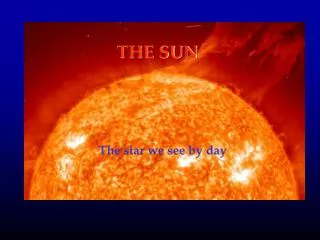
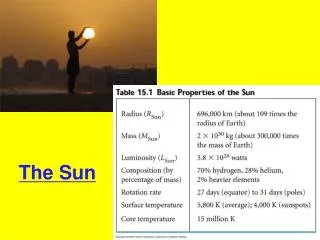
The Sun • Our closest star (a yellow dwarf) • Source of all energy on Earth • Located 149 million km from Earth or 1 AU (Astronomical Units) • Light takes a million years to get from the core to the Sun’s surface but only 8 minutes to reach us
The Sun • Rotates on its axis and orbits the galaxy, same as us • About half way through its 10 billion year life cycle • Sun will swell into a red giant, then cool to form a brown or black dwarf
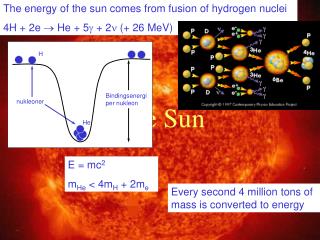
The Core • 25% of its radius • Intense pressure causes nuclear fusion – atoms of hydrogen fuse to form helium • Gives off huge amounts of energy (a billion 1 Mt nuclear blasts per second)
The Interior Radiative Zone • 45% of Sun’s radius • Energy carried out by photons (light energy) • Takes huge amount of time to get through
The Interior Convective Zone • 30% of Sun’s radius • Waves of hot gas • Carry energy outward to surface
The Atmosphere • Made up of 3 parts: the photosphere, the chromosphere, and the corona
The Atmosphere Photosphere • The surface of the Sun • 300 – 400 km wide • 6000˚ Celsius
The Atmosphere Chromosphere • Above photosphere (about 2000 km) • Convection currents cause temp. to rise to 10000˚ Celsius
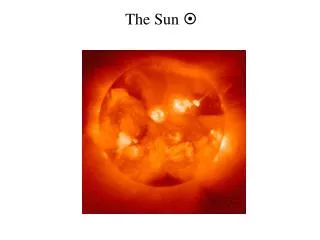
The Atmosphere Corona • Extend millions of km out in space • Best seen during a solar eclipse or X-ray of the Sun • About 1000000˚C – perhaps due to Sun’s magnetism
Solar X-Ray Photosphere Chromosphere Corona
Other Features Sunspots • Darker, cooler regions on the surface • Intense magnetic field • Runs in an 11 year cycle (2010 is when sunspots are at a minimum)
Other Features Prominences • Clouds of gas from the chromosphere • Rise up along magnetic lines from sunspots Solar Flares • Violent eruptions from the Sun • Release intense radiation which cause auroras (Northern Lights)
Life of a Star • The fate of a star depends on its size Dwarf Stars • Like our sun, will swell up (red giant) then slowly burn out (white dwarf then black dwarf) • Will take several billion years
Fate of the Sun • http://videos.howstuffworks.com/science-channel/6566-destiny-the-suns-fate-video.htm
Life of a Star Huge or Giant Stars • Will become a supergiant, then explode into a supernova (core instantly collapses) • Eventually ends up as a neutron star or a black hole
Neutron Star • 1.5 – 3 times mass of Sun • Core shrinks to diameter of 10 km, mass still double the Sun • Huge magnetic field and rapid spin
Black Hole • > 3 times mass of Sun • Contracts tremendously • Gravitation pull so strong not even light can escape!