Download
1 / 12
120 likes | 230 Views
This article examines two theoretical models of spin transfer from virtual photons to quarks. Utilizing the Lund model for hadron production, it discusses how quark pair creation serves as the kernel of exclusive reactions. We analyze production rates influenced by quark mass and charge, emphasizing distinctions between models through comparative ratios. The implications of recent findings from a Hall C experiment shed light on the potential limits of quark models. This investigation is crucial for refining our understanding of particle production dynamics.

E N D
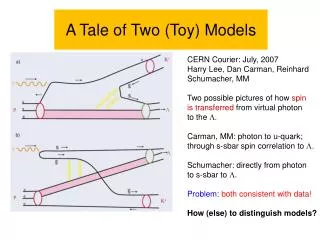
A Tale of Two (Toy) Models CERN Courier: July, 2007 Harry Lee, Dan Carman, Reinhard Schumacher, MM Two possible pictures of how spin is transferred from virtual photon to the L. Carman, MM: photon to u-quark; through s-sbar spin correlation to L. Schumacher: directly from photon to s-sbar to L. Problem: both consistent with data! How (else) to distinguish models?
Quark Pair Creation • Quark-pair creation: “kernel” of exclusive production • What field couples to the q-q current? u d S L ss produced From flux-tube s u s u K+ ss produced from photon K+ s u d L
Using Exclusive Production to Study Quark Pair Creation • Lund model: successful phenomenology for hadron production; e.g. in e+e- reactions • color flux-tube broken by qq production • production rate depends on constituent quark mass • : : ~ 1 : 1 : 0.2 • Vector meson dominance: photon fluctuates into a virtual qq meson • production rate depends on quark charge • : : ~ 1: 0.25 : 0.25 ss ss uu uu dd dd
Distinguish ModelsStudy ratios of s s : dd : uu • Measure ratios: K+L : p+n : p0p K+ p0 p+ s d u n p L s u d 0.2 : 1 : 1 Ratio : exponential in quark mass
Distinguish Models • Measure ratios: K+L : p+n : p0p K+ L n p s d u s p+ p0 d u 1 : 1 : 4 Ratio : proportional to (charge)2
90k 420k 540k 480k • Missing Mass • 2-body final state (n) p+a P (p0)a ~0 84k 350k 910k forward f Lab Angle g backward
50k 150k 45k 5k K+ Missing Mass (L) K+a “Fake” plots mis-identified protons mis-identified pions forward f Lab Angle g backward
Limits of the “quark model” ? Can the Lund model work in the limit of single qq pair production? • recent analysis of a Hall C p+(n) production experiment • Kaskulov, Gallmeister, Mosel; arXiv:0804.1834v4 [hep-ph] • model was developed to explain Rosenbluth separated exclusive electro-production of p+(n) asLdescribed well as t-channel exchange asTdescribed well as “quark-scattering followed by string-breaking” with Lund model parameters • model also works for un-separated data
Exclusive np+: sum of two processes sT: DIS via LUND model sL: t-channel exchange u d d photon probes meson structure n photon couples to quark d u p+ t-channel no form factor: q2 independent form factor falls with q2
Analysis goals and plans • Model-independent goal • measure ratio of p+n : p0p : K+L cross-sections • proportional to uu : dd : ss rate • Extend Kaskulov, Gallmeister, Mosel model • extend to dd and ss production • Analysis plan • identify final states (done) • decide on binning ( high/low bins for W, q2, t ) • tune PYTHIA/JETSET (fitting and MC generator) • Study single quark-pair creation
An interesting observation …. For forward-going protons (qLAB < 200) : only recoil meson is the r0 ??
And the winner is …. crude accepance correction done; kaon decay not corrected Ratio: K+L : p+n : p0p 0.23 : 0.88 : 1.12 errors ~ 20% ??