Understanding Freud’s Conscience: The Id, Ego, and Superego Explained
This guide explores the foundations of Freud’s concept of conscience, focusing on the roles of the id, ego, and superego. The agenda includes examining how these three components develop and interact, as well as addressing Gula's objection. Additionally, participants will engage in reflective exercises, categorizing personal characteristics into three columns: instinctual desires, self-descriptions, and external influences. The reading and homework will deepen understanding of the Oedipus and Electra complexes and their impact on feelings of guilt, shaping our sense of conscience.

Understanding Freud’s Conscience: The Id, Ego, and Superego Explained
E N D
Presentation Transcript
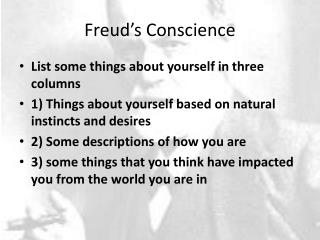
Freud’s Conscience • List some things about yourself in three columns • 1) Things about yourself based on natural instincts and desires • 2) Some descriptions of how you are • 3) some things that you think have impacted you from the world you are in
Freud • Agenda… • To understand the foundations and motivations behind Freud’s notion of the conscience • To consider how the id, ego and superego develop and work together • To understand Gula’s objection • Homework… • Ext/Hwk – Read and take notes on Gulahandout and answer the questions on sheet
Foundations of Guilt • Oedipus Complex – • The son sexually desires his Mum • Electra Complex – • The daughter sexually desires her Dad (not as strongly) We feel guilty about this and this feeling is the basis of our conscience
1 - ID • Inner, animalistic desires and natural passions
2 – Ego • Conscious image that we present of ourselves. Reasoned, reflective and ID limiting.
3 - Superego • Socially developed and internalised sense of good and bad. • Subconscious • Based on guilt
Task • 1 – On handout, read each statement and highlight it according to whether it relates to the ID, Ego or Superego • 2 – Diagrammatically depict Freud’s conscience, including the three aspects of self and guilt