Understanding Recursive Algorithms and Data Structures in Applied Algorithmics
This week’s focus is on recursive algorithms and data structures essential for algorithm design. Recursive procedures help solve complex problems by breaking them down into smaller sub-problems, always ensuring a base case. We explore recurrence equations which describe the running time of these algorithms. The choice of appropriate data structures, like stacks and queues, significantly impacts efficiency. Stacks operate on a LIFO principle for method invocations in recursion, while queues use FIFO for managing objects. Understanding these concepts lays the groundwork for effective algorithmic solutions.

Understanding Recursive Algorithms and Data Structures in Applied Algorithmics
E N D
Presentation Transcript
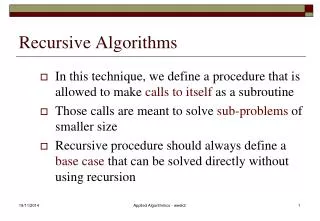
Recursive Algorithms • In this technique, we define a procedure that is allowed to make calls to itself as a subroutine • Those calls are meant to solve sub-problems of smaller size • Recursive procedure should always define a base case that can be solved directly without using recursion Applied Algorithmics - week2
Recursive procedure Applied Algorithmics - week2
Recurrence Equation • Recurrence equation defines mathematical statements that the running time of a recursive algorithm must satisfy • Function T(n) denotes the running time of the algorithm on an input size n, e.g., • Ideally, we would like to characterize a recurrence equation in closed form, e.g., T(n)=7(n-1)+3 =7n -4 = O(n) Applied Algorithmics - week2
Data Structures • An important element in the design of any algorithmic solution is the right choice of the data structure • Data structures provide some mechanism for representing sets and operations defined on set elements • Some basic and general data structures appear as elements of programming languages, e.g., as types: arrays, strings, sets, records, …) • Some other: abstract data structures are more specialised and complex (stacks, queues, lists, trees, graphs, …) Applied Algorithmics - week2
Data Structures • Typical operations defined on data structures: • checking (set) membership • accessing indexed elements • insertion/deletion/update • more complex (set of objects) querying • The efficiency of operations provided by the data structures is usually related to the level of ordering of stored data. Applied Algorithmics - week2
Stacks • Objects can be inserted into a stack at any time, but only the most recently inserted (“last”) object can be removed at any time • E.g., Internet Web browsers store the address of recently visited sites on a stack • A stack is a container of objects that are inserted according to the last in first out (LIFO) principle Applied Algorithmics - week2
Stack Abstract Data Type • A stack is an abstract data type (ADT) supporting the following two methods • push(o) : insert object o at the top of the stack • pop() : remove from the stack and return the top object on the stack; an error occurs if the stack is empty Applied Algorithmics - week2
Stack (supporting methods) • The stack supporting methods are: • size() : return the number of objects in the stack • isEmpty() : return a Boolean indicating if the stack is empty • top() : return the top object on the stack, without removing it; an errors occurs if the stack is empty Applied Algorithmics - week2
Stack (array implementation) • A stack can be implemented with an N-element array S, with elements stored from S[0] to S[t], where t is an integer that gives the index of the top element in S Applied Algorithmics - week2
Stack Main Methods Applied Algorithmics - week2
Stack Methods Complexity • each of the stack methods executes a constant number of statements • all supporting methods of the Stack ADT can be easily implemented in constant time • thus, in array implementation of stack ADT each method runs in O(1) time Applied Algorithmics - week2
Stack (application) • Stacks are important application to the run-time environments of modern procedural languages (C,C++,Java) • Each thread in a running program written in one of these languages has a private stack, method stack, which is used to keep track of local variables and other important information on methods Applied Algorithmics - week2
Stack (application) Applied Algorithmics - week2
Stack (recursion) • One of the benefits of using stack to implement method invocation is that it allows programs to use recursion • Recursion is a powerful method, as it often allows to design simple and efficient programs for fairly difficult problems Applied Algorithmics - week2
Queues • A queue is a container of objects that are inserted according to the first in first out (FIFO) principle • Objects can be inserted into a queue at any time, but only the element that was in the queue the longest can be removed at any time • We say that elements enter the queue at the rear and are removed from the front Applied Algorithmics - week2
Queue ADT • The queue ADT supports the following two fundamental methods • enqueue(o) : insert object o at the rear of the queue • dequeue(o) : remove and return from the queue the object at the front; an error occurs if the queue is empty Applied Algorithmics - week2
Queue (supporting methods) • The queue supporting methods are • size() : return the number of objects in the queue • isEmpty() : return a Boolean value indicating whether the queue is empty • front() : return, but do not remove, the front object in the queue; an error occurs if the queue is empty Applied Algorithmics - week2
Queue (array implementation) • A queue can be implemented an N-element array Q, with elements stored from S[f] to S[r] (mod N) • f is an index of Q storing the first element of the queue (if not empty) • r is an index to the next available array cell in Q (if Q is not full) Applied Algorithmics - week2
Queue (array implementation) • Normal (f r) configuration (a) and wrap around (f > r) configuration (b) Applied Algorithmics - week2
Queue (main methods) Applied Algorithmics - week2
Queue Methods Complexity • each of the queue methods executes a constant number of statements • all supporting methods of the queue ADT can be easily implemented in constant time • thus, in array implementation of queue ADT each method runs in O(1) time Applied Algorithmics - week2
Queue and Multiprogramming • Multiprogramming is a way of achieving a limited form of parallelism • It allows to run multiple tasks or computational threads at the same time • E.g., one thread can be responsible for catching mouse clicks while others can be responsible for moving parts of animation around in a screen canvas Applied Algorithmics - week2
Queue and Multiprogramming • When we design a program or operating system that uses multiple threads, we must disallow an individual thread to monopolise the CPU, in order to avoid application or applethanging • One of the solutions is to utilise a queue to allocate the CPU time to the running threats in the round-robin protocol. Applied Algorithmics - week2
Linked List • A node in a singly linked list stores in a next link a reference to the next node in the list (traversing in only one direction is possible) • A node in a doubly linked list stores two references – a next link, and a previous link which points to the previous node in the list (traversing in two two directions is possible) Applied Algorithmics - week2
Doubly Linked List • Doubly linked list with two sentinel (dummy) nodes header and trailer Applied Algorithmics - week2
List Update (element insertion) Applied Algorithmics - week2
List Update (element removal) Applied Algorithmics - week2
List Update (complexity) • What is the cost (complexity) of both insertion and removal update? • If the address of element at position p is known, the cost of an update is O(1) • If only the address of a header is known, the cost of an update is O(p) (we need to traverse the list from position 0 up to p) Applied Algorithmics - week2
Rooted Tree • A treeT is a set of nodes storing elements in a parent-child relationship, s.t., • T has a special node r, called the root of T • Each node v of T different from r has a parent node u. Applied Algorithmics - week2
Rooted Tree • If node u is a parent of node v, we say that v is a child of u • Two nodes that are children of the same parent are siblings • A node is external (leaf) if it has no children, and it is internal otherwise • Parent-child relationship naturally extends to ancestor-descendant relationship • A tree is ordered if there a linear ordering defined for the children of each node Applied Algorithmics - week2
Binary Tree • A binary tree is an ordered tree in which every node has at most two children • A binary tree is proper if each internal node has exactly two children • Each child in a binary tree is labelled as either a left child or a right child Applied Algorithmics - week2
Binary Tree (arithm. expression) • External node is a variable or a constant • Internal node defines arithmetic operation on its children [(3 + 1) · 3]/[(9 - 5) + 2] – [3 · (7-4) + 6] = -13 Applied Algorithmics - week2
The Depth in a Tree • The depth of v is the number of ancestors of v, excluding v itself Applied Algorithmics - week2
The Height of a Tree • The height of a tree is equal to the maximum depth of an external node in it Applied Algorithmics - week2
Data Structures for Trees • Vector-based structure: • v is the root -> p(v) = 1 • v is the left child of u -> p(v) = 2· p(u) • v is the right child of u -> p(v) = 2· p(u) +1 • The numbering functionp() is known as a level numbering of the nodes in a binary tree. • Efficient representation for proper binary trees Applied Algorithmics - week2
Data Structures for Trees Applied Algorithmics - week2
Data Structures for Trees • Linked structure : each node v of T is represented by an object with references to the element stored at v and positions of its parent and children Applied Algorithmics - week2
Priority Queue • Priority queue is an abstract data structure used to store elements from the ordered (≤) set • The operations defined on priority queue PQ • Create(PQ) – creates empty priority queue PQ • Insert(PQ, el) – inserts element el to PQ • RemoveMin(PQ) – removes minimal element from PQ • Min(PQ) – gives the value of the minimal element Applied Algorithmics - week2
Heap Data Structure • A heap is a realisation of PQ that is efficient for both insertions and removals • heap allows to perform both insertions and removals in logarithmic time • In heap the elements and their keys are stored in (almost complete) binary tree Applied Algorithmics - week2
Heap-Order Property • In a heapT, for every nodev other than the root, the key stored at v is greater than (or equal) to the key stored at its parent Applied Algorithmics - week2
PQ/Heap Implementation • heap: complete binary treeT containing elements with keys satisfying heap-order property; implemented using a vector representation • last: reference to the last used node of T • comp: comparator that defines the total order relation on keys and maintains the minimum element at the root of T Applied Algorithmics - week2
PQ/Heap Implementation Applied Algorithmics - week2
Up-Heap Bubbling (insertion) Applied Algorithmics - week2
Up-Heap Bubbling (insertion) Applied Algorithmics - week2
Down-Heap Bubbling (removal) Applied Algorithmics - week2
Down-Heap Bubbling (removal) Applied Algorithmics - week2
Heap Performance • Operation times: • Create(PQ): O(1) • Min(PQ): O(1) • Insert(PQ, el): O(log n) • RemoveMin(PQ): O(log n) • Heaps have several applications including sorting (Heap-sort) and data compression (Huffman coding). Applied Algorithmics - week2
Heap-Sorting • Theorem: The heap-sort algorithm sorts a sequence of S of n comparable elements, e.g., numbers, in time O(n log n), where • Bottom-up construction of heap with n items takes O(n) units of time, and • Extraction of n elements (in increasing order) from the heap takes O(n log n) units of time Applied Algorithmics - week2
Representation of sets • We already know that sets can be represented in many ways as different types of data structures • Efficiency of set representation depends on its size and application • Small sets can be represented as characteristic vectors (binary arrays), where: • the array is indexed by the set elements • the entries are either 1 (element is in) or 0 (otherwise) Applied Algorithmics - week2
Example • A subset of the universal set U={0,1,2,3,4,5,6,7,8,9} can be represented as any binary array of length 10 • For example, the subset S of odd numbers from U, i.e., S={1,3,5,7,9} can be represented as: Applied Algorithmics - week2