Advanced Automatic Fingerprint Acquisition System through Hardware-Software Co-Design
170 likes | 290 Views
This paper presents an innovative Automatic Fingerprint Acquisition System that utilizes a Hardware-Software co-design approach. By integrating various sensor technologies, including optical, ultrasound, and silicon-based sensors, the system efficiently utilizes both hardware and software to optimize fingerprint recognition. Key components of the system, such as image acquisition and reconstruction, are discussed, including the effective task partitioning between hardware and software. The results indicate a low-cost solution that improves security mechanisms, laying the groundwork for future enhancements in biometric systems.


Advanced Automatic Fingerprint Acquisition System through Hardware-Software Co-Design
E N D
Presentation Transcript
Automatic Fingerprint Acquisition System An example employing Hardware-Software Co-Design - Komalkasat Nalini Kumar GauravChitroda
Outline • Motivation • Introduction • Finger-print Based Sensors • System-On-Chip Architectures • Hardware-Software System Co-Design • Results and Conclusions • Future Work
Motivation • Differences in Biological characteristics • Using them to improve security • Using them in place of Pins and Passwords • Fingerprint Recognition systems
Introduction • Stages of Biometric Recognition Process - Enrolment: Measurement of particular Biometric characteristic of user - Authentication: Comparison of stored template and current input. - Processing and Action Phase • Fingerprint Recognition Systems: - Ridges and Valleys Identification - Fingerprint Pores
Finger-print based sensors • Optical sensors • Ultrasound sensors • RF sensors • Silicon based Sensors • Pressure based sensors • Capacitance based sensors • Thermal sensors
Hardware-Software Co-Design • Overview : The paper focuses on the first stage of the System • Acquisition and Reconstruction
HW-SW partitioning • Compute-intensive tasks are selected to be implemented by Hardware - Image Acquisition and Reconstruction • Less intensive tasks are implemented by Software running on Microprocessor - Sequence of steps or scheduling - Detection of finger on sensor
HARDWARE TASKS SOFTWARE TASKS No Finger On Sensor T I M E S E Q U E N C E Finger On Sensor 1 Task 1: Finger Detection 2 3 4 Task 4: Image Storage Task 2: Slice Acquisition Task 3: Image Reconstruction No Finger On Sensor Finger On Sensor 5 Task 5: END Fingerprint Acquisition
Image Acquisition Stage • A) Handling of the sensor to get the fingerprint slices • B) Storage of the captured slices in a correct way
Reconstruction On-the-Fly Stage • Tasks in Reconstruction Stage: • Management of the concurrent acquisition stage, • Reconstruction of the fingerprint image from the acquired slices • Handshaking with the microcontroller in order to allow the image storage process.
Overlap is found between the first and second slices by line comparison. • After detection of overlap an interrupt is generated to the microcontroller to transfer the overlapped lines to memory. • Repeated till done or finger taken off
Acquisition time is obviously dependent on finger sliding speed. • But good quality fingerprint images can be obtained at freq of 200 slices/sec.
Results and Conclusions • The platform permits the Hw-Sw co-design of medium-low complex systems. • The described architecture has provided the authors with a low-cost solution. • The first stage of the Automated Fingerprint identification system is detailed.
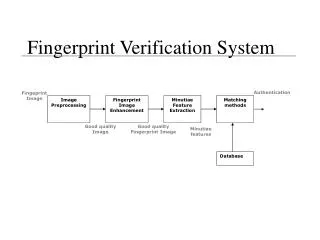
Future Work • To develop further stages: - image enhancement phase - Signature Extraction - Signature Storage - Biometric matching - Encryption of the verification result