The Anatomy of Tissues and Blood Composition
490 likes | 527 Views
Explore the intricate structures of tissues and hematopoiesis, including epithelia, glands, and blood cell formation. Learn about the theories and classifications of hematopoietic cells.


The Anatomy of Tissues and Blood Composition
E N D
Presentation Transcript
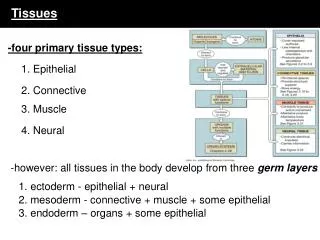
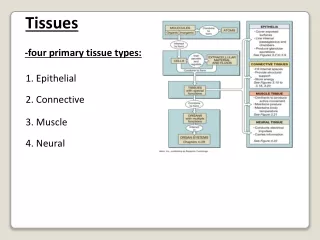
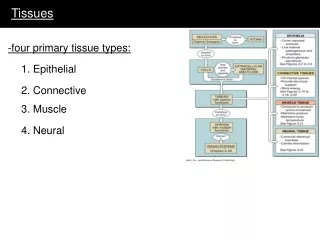
Tissues • Tissue – aggregation of cells and noncellular structures, which have similar structure, function and development • General • 1. Epithelia • 2. Inner environment (blood and connective) • Special • 1. Muscular • 2. Nerve
Stratified epithelia:1. Stratified squamous nonkeratinized2. Stratified squamous keratinized3. Transitional (urothelium)
Blood and hematopoiesis • Blood compounds and functions • Plasma • Erythrocytes • Leucocytes • Theories of hematopoiesis 6. Stem cell structure and functions 7. Embryonic and postembryonic hematopoiesis 8. Classes of hematopoietic cells 9. Main features of different hematopoietic lines
Functions • 1. Trophic • 2. Respiration • 3. Protection • 4. Excretion • 5. Homeostasis • 6. Transport
HEMATOPOIESIS –blood compounds development (blood cells and plasma) Hematocytopoiesis Erythrocytopoiesis Leucocytopoiesis granulocytopoiesis agranulocytopoiesis Trombocytopoiesis
THEORIES OF HEMATOPOIESIS • POLYPHYLETIC THEORY – each mature blood cell type is derived from its own distinct stem cell • MONOPHYLETIC THEORY (A.A. Maximov) – there is one stem cell, which can form all the mature blood cells types. • Multipotential stem cell (CFU-S – colony-forming-unit of spleen)
Hematopoietic stem cell • 1. Appears in the yolk sac • 2. Thrives in RBM • 3. Similar to small dark lymphocyte • 4. Migrating cell • 5. Pluripotential cell (gives rise to different cells) • 6. Self-supporting cell • 7. Rarely dividing cell (Go) • 8. Sensitive cell
Differences between embryonic and postembryonic hematopoiesis
CLASSES OF HEMATOPOIETIC CELLS • I class – polipotent (pluripotent) stem cell. • II class – hemistem cells for lymphocytopoiesis and myelopoiesis. • III class – unipotent cell (committed) sensitive to exact hemopoietin (erythropoietin, leykopoietin, thrombopoietin). • IV class – blasts (young actively dividing cells). • V class – maturing cells. • VI class – an “adult” mature cells in peripheral blood.
1. Decrease in cell size (from 20 till 8 мm)2. Ejection (extrusion) of the nucleus3. Accumulation of hemoglobin in the cytoplasm4. Basophily decrease and acidophily increase
GRANULOCYTOPOIESIS • 1. Decrease in the cell size • 2. Chromatin condensation • 3. Changes in nuclear shape (flattening – indentation – lobulation). • 4. Accumulation of cytoplasmic granules.
LYMPHOCYTOPOIESIS • 1. Begins in red bone marrow and then continues in lymphoid tissue. • 2. Lifespan various in different types of lymphocytes. • 3. Antigenindependent development – in the central hematopoietic organs (red bone marrow and thymus) and antigendependent – in peripheral ones (spleen, lymph nodes and nodules).
MONOCYTOPOIESIS • 1. Decrease in cell diameter. • 2. Decrease in nuclear diameter. • 3. Cytoplasm basophily decreases. • 4. Nucleus changes its shape from round to kidney-like