Download
1 / 23
230 likes | 344 Views
This resource explores the various forms of energy, including potential, kinetic, sound, thermal, light, electrical, and chemical energy. It highlights how energy can cause changes in motion, temperature, and matter. The principles of energy transformation, electricity, and their applications in daily life are explained with relatable examples, making complex concepts accessible to learners. Discover the basics of electric charge, the interaction of charged particles, and the functions of electric currents, motors, and generators.

E N D
Forms of Energy Big Idea 10 and 11
Forms of energy • ____ ________ ___________ ______ • TV turns on bicycle moves food digests • toaster pops top spins nail rusts • computer powers up bowling pin falls battery turns on flashlight • iPod plays faucet turns on log rots • cell phone recharges pinwheel turns wood burns
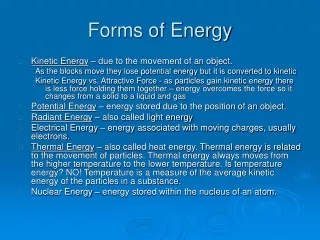
What is Energy? • Energy is the ability to cause change. • Change in matter • Change in temperature
Energy… • Energy can never be created nor destroyed….energy can be transformed from one form to another.
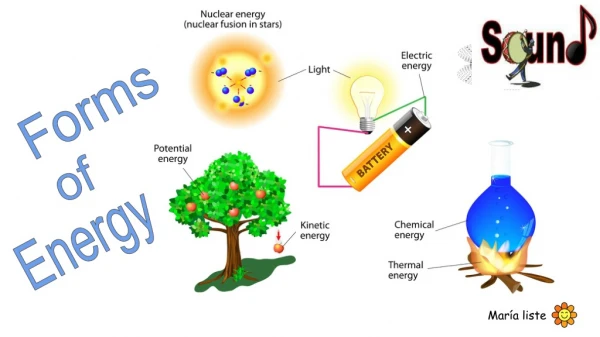
Potential & Kinetic • Energy an object has because of their position or condition is POTENTIAL ENERGY (PE). • Energy an object has because of its motion is KINETIC ENERGY (KE).
MECHANICAL • The total energy of motion and position on an object is mechanical energy. • PE + KE = ME
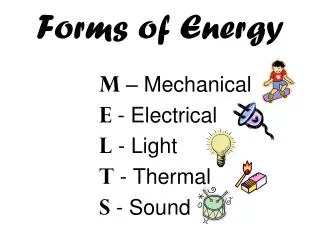
SOUND • Form of energy carried through waves in vibrating matter • It is a type of kinetic energy because particles are moving.
Thermal/HEAT • Particles are moving, therefore a type of kinetic energy
Light • Light is a form of energy that can travel through space and some types of matter like air or glass.
Electrical • Energy that is caused by the movement of electric charges
Chemical • Energy that is stored in matter and released by a chemical reaction. • Example: food, gas
Recap • ________ energy is the total kinetic energy of the particles in matter. • ________ energy is energy that can be released by a chemical reaction. • _______ energy is the form of energy that you can see. • ______ energy travels as waves through vibrating matter. • ____________ energy is the combination of the potential and kinetic energy an object contains. • __________ energy is energy caused by movement of electrical charge.
Choose the correct word • Energy is the ability to cause motion or create (matter/ change). • There are two main categories of energy- potential and (thermal/ kinetic). • Energy cant’s be created or (destroyed/ captured). • Energy can change from one form to another, which is called (transformation/ conservation).
What changes can energy cause? • Change in temperature • Change in matter
What is Electricity? • Electric charge is a property of a particle that affects how it behaves around other particles. • When an atom has an equal number of protons and electrons, the positive and negative charges cancel each other and the atom has no charge. • If an atom gains an electron it will have a charge of -1. • If an atom loses an electron it will have a charge of +1.
Electricity • Particles with the same charge repel (push away). • Particles with opposite charges attract (pull together). • Example: static electricity is a build up of charges. Dryer. Car, zapping a person, lightning
Electricity • Electric current • Metals are good conductors because they contain electrons that move through easily.
How do electric changes interact?LESSON4 Repel Attract
How do we use electricity? • Candle vs. Lamp • Hand saw vs. circular saw • Gramophone vs. ipod • Hand fan to electric fan • Megaphone to electric speaker
Electromagnet • Current produces magnetism
Generator vs. Electric motor • It is the opposite of an electric motor. • Electric motor.. Electric current passes through the coil producing a magnetic field that causes the shaft to rotate, then a blade or other things attached move. electric -> movement • In a generator movement of some outside source (wind or water) cause the magnet to move inside the coil of wire which generates an electric current. Movement ->electricity