Download

1 / 9
0 likes | 4 Views
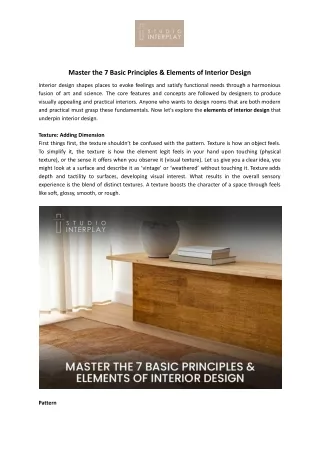
The 7 elements of interior designu2014space, line, form, light, color, texture, and patternu2014are the building blocks that define and shape a room. These elements help create mood, functionality, and visual appeal. The 7 principlesu2014balance, rhythm, emphasis, contrast, scale/proportion, harmony, and unityu2014guide how these elements are used effectively. Together, they ensure a well-designed, cohesive, and aesthetically pleasing space.<br>https://www.pinterest.com/mmunazza02/<br>http://business-user.great-site.net/wp-admin/post.php?post=38&action=edit

E N D
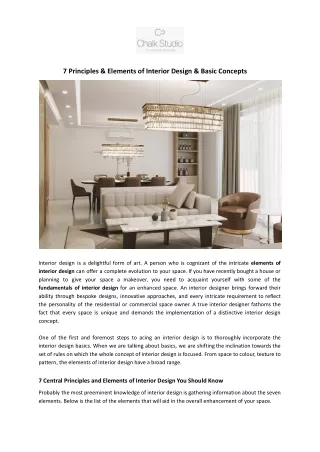
7 Elements and Principles of Interior Design & Basic Concepts by interior designing.com The practice of interior design surpasses furniture set-up because it involves the scientific process and artistic approach to enhance interior spaces to create spaces with better visual appeal and health benefits for occupants. At its core, successful interior design hinges on a fundamental understanding and skillful application of its key elements and principles. The rules form the basic structure rather than random guidelines. 1.space: The foundation of all design elements exists in space as the vital architectural element which architects use to construct their designs. The actual room size lies between the walls and floor which extend up to reach the ceiling. A designer explores positive space which indicates occupied object areas while studying negative space which includes all empty spaces around objects. Proper management of
spatial areas creates necessary functional pathways and casual movements. A room which receives excellent design treatment will strike a proper balance and enable natural ease of movement throughout. Positive space clutter will cause spaces to become cramped whereas excessive negative space leads to feelings of emptiness and disconnection. The start of every design project requires identifying fundamental space dimensions and recognizing possible uses of the space. 2.line: architectural elements and planned furniture placement. Line extends its boundaries to include the outer limits of physical things and architectural components together with explicit pathways produced by arranged Interior design line goes beyond schematic drawings extending to physical edges of objects and furnishings. The alignment of lines between horizontal, vertical and diagonal shapes provides stability and calmness or height sensation and energy patterns. Mild and flowing elements result from using curved line formations in design work.
3.form: The planned application of line positions viewer attention while simultaneously outlining forms and establishing visual appeal in space. The correct placement of vertical bookshelves enhances ceiling height while a horizontal sofa structure stretches the perceived room dimensions. 4.Light: Light plays the most significant role by forming how we perceive space since it directs both mood and color and surface appearance. Regular sunlight entering through windows enables outdoor connections which produce an open and energetic room atmosphere. Artificial lighting provides controlled environments because it enables creators to layer different lighting effects according to their needs. The environment receives illumination from ambient lighting and essential activities benefit from task lighting unless accent lighting highlights specific points. The specific direction together with intense lighting and color temperature of a space prove essential for creating successful interior designs.
5.Color: The force of color serves two functions by activating emotional responses while letting us establish specific spatial moods. Environmental lighting affects our emotional state and controls our space size evaluation as well as our food consumption. The fundamental knowledge of color theory through principles such as the color wheel with harmonies and contrasts must be known by designers. Most interior spaces feel stimulating and welcoming because of warm colors such as reds, oranges and yellows but cool hues including blues, greens and purples tend to create peaceful and relaxed atmospheres. A background of neutral tones continues to work for any additional decorating elements. Strategically deploying color allows designers to establish areas in a room along with making architectural components stand out or creating continuous visual paths. 6.Texture: The surface quality of objects exists in two forms that depict both tactile sensations and visual appearance. A space receives an extra dimension together with touch-oriented intrigue through the use of texture. Different materials in interior spaces display varying degrees of smoothness (glass with metal facing versus stone with burlap) and hardness (a smooth wooden surface versus tile tiles). Moving textures between each other creates spaces that attract attention by increasing their sensory quality. A velvet cushion on leather furniture produces opposite visual effects compared to how a rough wooden surface interferes with smooth plaster walls. 7.pattern: ↗ Pattern represents the recurring display of visual components such as lines and shapes and colors to build visual composition. اب نیا دوجو هدافتسا اهنآ دیاب اب ساوسو ماجنا هدش ات هب حیارط کیمک دنزادنین . You will find patterns expressed in textiles as well as wallpapers while rugs together with decorative accessories. Achieving pattern mix success requires a detailed evaluation of design scale together with color selection and room style elements. The key principle for using patterns effectively in a space includes changing their sizes while keeping all elements linked through shared color schemes. دنروخرپ صخش و للجم هب طیحم دعب ات دنناوت اهروطارقم می
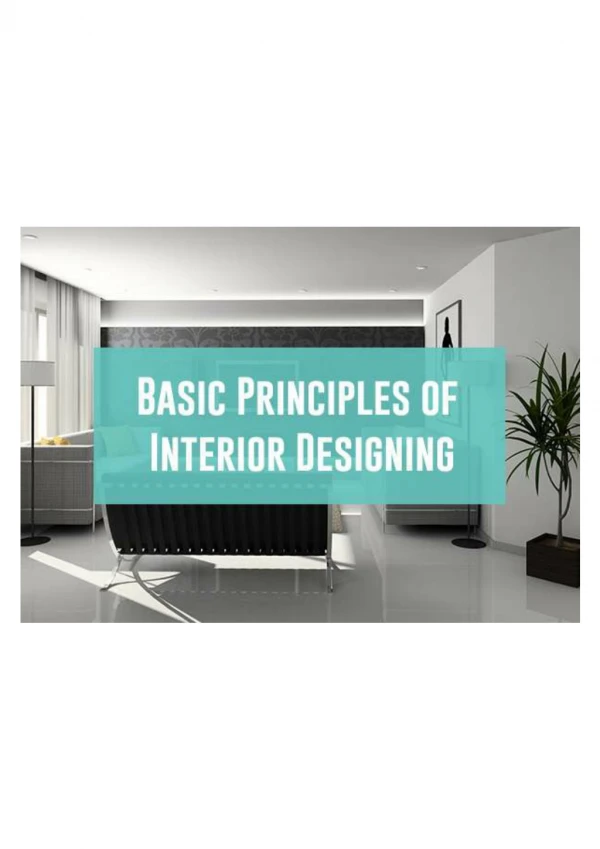
The Seven Guiding Principles of Interior Design: The Rules of Harmony 1.balance: The foundational elements provide the foundations for design yet principles serve as directives controlling their organization which produces harmonious effective final compositions. The principles serve as an organizational structure to build spaces which are both attractive and functional. Any visual arrangement maintains its stability because Balance refers to the way visual weight spreads throughout the space. A well-balance composition helps establish both stability and equilibrium in the design. The fundamental types of balance include symmetrical, asymmetrical and radial arrangement. i.symmetrical balance: Symmetrical Balance happens through the duplication of design features across a vertical central line. Formal and traditional visuals emerge because of this technique. ii.asymmetrical balance: Asymmetric balance results when two or more elements with dissimilar visual weightfulness work together to balance out the composition. The layout produces a sense of dynamism through this method. iii.radial balance: In radial balance elements spread out in a direction from one central location. A centered focal point together with unity develops from this effect. 2.Harmony$unity: A space achieves proportion by establishing a relationship between all elements based on their size dimensions. Size determination through the human body perspective and room dimensions makes up the concept of scale. Good proportion coupled with appropriate scale help to produce environments which are comfortable and visually pleasing. A room becomes limited when its furniture exceeds the size of its boundaries because the space feels compressed by powerful dimensions. Similarly a well-sized room loses the visual balance of its displays if the accessories create a negative impression against its general volume.
3.Emphasis: Emphasis represents the method for focusing attention through a point of interest known as focal point. Every room needs to feature at least a single focal point in its designing. In room design one focal point should be selected from architectural elements or artwork with dramatic windows or perfectly arranged furniture setups. Both visual dominance and directional flow of gaze through space should be established by the main focal point. 4.Flow: The visual flow in a space is formed through the repetitive utilization of design elements as well as their variations that create movement in design. This design principle is called rhythm. The visual guide directs viewers to move their eyes across space elements. Rhythm can be achieved through: Regular intervals of repetition produce design elements such as colors, patterns, textures or forms in a space. The alternation technique combines two or more essential elements into deepened rhythmic patterns. An element brings about incremental changes in its attributes including measurement and tone levels and visual intensity degrees. The transition process uses a connecting element to guide the visual journey from one element to another. 5 Harmony: serves as the principle which unites space elements into a harmonious cohesive environment. A happy and balanced connection emerges among elements when they work together successfully. Unity in design does not require complete uniformity yet brings together every aspect to share a visual bond of agreement through design components. Three common approaches to achieve this principle include structured color schemes, repetitive design styles or the use of coordinating textures. 6.unity: Unity describes the sensation that every space element aligns to establish a harmonious connection within the whole composition. A design reaches its ultimate state through a feeling that the layout has come together perfectly. The hierarchical arrangement of elements which pleases viewers demonstrates the same level of coherence as the organizational strength that brings together individual parts into a unified conceptual vision. A conjunction of design elements produces an intended and purposeful appearance.
7 Pattern : Designs that repeat themselves occur in fabrics as well as wallpapers and decorative items belong to this category. They can be: Geometric (stripes, chevron) Floral (organic, nature-inspired) Abstract (artistic, unconventional) A space benefits from patterns that enhance personality yet patterns become oppressive if they take over a space. The 7 Principles of Interior Design: The principles of interior design function as regulating concepts which direct element usage. These principles maintain harmony as well as balance and cohesion when designing a space. 1 Balance: Balance creates visual stability. There are three types: Symmetrical Balance :mirror-image arrangement Formal and orderly. Asymmetrical Balance :different objects with equal visual weight Dynamic and modern. Rooms with circular structures often use radial balance to display their design elements at various points extending from a central point. 2 Rhythm & Repetition : Rhythm generates movement by using repetitive sequences or by advancing elements or creating contrasting contrasts. Techniques include: The strategy of repetition involves repeated usage of colors and figures and patterns. Alternation: switching between two elements Gradation:gradual change in size or color A well-structured rhythm enables the eyes to move effortlessly through a space. 3 Harmony & Unity: Consistent color schemes
Every part of the design maintains harmony to create unified cohesion. A design achieves unity when all structural components seem interconnected with each other. This is achieved through: Consistent color schemes Complementary furniture styles Coordinated textures and patterns 4 Contrast: Contrast creates excitement by combining elements which are opposites. Light vs. dark colors Rough vs. smooth textures Modern vs. traditional furniture Just as contrast functions to avoid tedium it enables elements to stand out. 5 Emphasis (Focal Point): Each space demands an obvious main element which becomes the visual center point. Examples: A fireplace An accent wall A statement piece of furniture The design gets its anchor from the focal point. 6 Proportion & Scale: Proportion refers to the ratio between elements. The size of a feature determines its scale in relation to other space dimensions. A small room becomes uncomfortable when using oversized furniture while using objects that are too small in a large space results in poor visual impact. An effective application of measurement techniques produces artwork that balances comfort and visual attractiveness. 7 Details:
A design attains its refinement through details which consist of trim work combined with hardware and accessories and finishing details matter. All rooms get their finishing touch from small components such as lighting fixtures and light fixtures and cabinet handles and stitching on cushions. Conclusion: Using both the 7 elements and 7 principles of interior design enables residential spaces and design professionals to produce areas that are usable along with visually appealing and unified. The regular implementation of balance, rhythm, harmony, contrast, emphasis, proportion, and detail enables any person to transform common rooms into astonishing environment. please read this more and clicking this link http://business-user.great-site.net/wp-admin/admin.php?page=td_theme_demos# https://img.photouploads.com/file/PhotoUploads-com/S4ux.jpg https://www.pinterest.com/mmunazza02/interior-design-by-interior-designing/